What my grandmother's jam jars tried to tell us
One in five Australians over 60 have sarcopenia, and women carry the steeper gradient. The screening is rare, the protein gap is real, and the intervention works at any age. A GP-turned-writer on what the medical system isn't catching.

My nonna was 82 when she stopped being able to open jars. She didn’t say anything. She’d just hand me the passata when I came over for Sunday lunch, casually, the way you’d pass someone a tea towel, and I’d twist the lid and hand it back. Months in, I worked out she was hiding it from my mum. She thought it meant the slide had started.
What she had, although nobody in the family called it that, was sarcopenia. Loss of muscle. The slow, mostly invisible kind that one in five Australians over 60 are now walking around with. It’s the medical word for what my nonna feared. The part she couldn’t have known: for a woman her age, it didn’t have to mean what she thought.
I trained as a GP in Brisbane. For most of my clinical years, sarcopenia barely came up. Older women presented with what you’d expect. Sleep. Joints. Blood pressure. The winter cough that took six weeks to clear. Muscle mass was a thing you noticed the way you notice the weather. We didn’t measure it. We didn’t ask. When a 71-year-old said she couldn’t get up from the kitchen chair without rocking forward twice, we wrote down decreased mobility and offered a physio referral if she pushed.
The disease only entered Australia’s formal classification system in 2019. Before then, technically, no one had it.
The numbers nobody wanted to put on the page
The Royal Australian College of GPs and the Medical Journal of Australia both circle the same figure. One in five Australians aged 60 and older. The Women’s Weekly carried it again this week, in a piece headlined “the overlooked health issue affecting older women”, citing the figure the way you’d cite the weather.
Inside that one-in-five, the gradient runs steeper for women than men, for reasons that turn out to be both obvious and underdiscussed. Women start with less muscle mass at every age. Then menopause arrives, oestrogen drops, and oestrogen, as it happens, is one of the chemicals telling the body to keep laying down protein. Take it away, the synthesis machinery slows. Fat goes up. Strength comes off.
Deakin University researchers have been mapping this curve for years. Their working figure: women’s muscle mass falls off a cliff after the early 40s if nothing is being asked of it. Not gradually. A cliff. I might be overstating it slightly, but walk into any clinic that does DEXA body-composition scans on women in their early 50s and you’ll see the data, lean-mass numbers ticking downward year on year while the woman herself feels fine and goes about her week.
The clinical literature calls this “asymptomatic”. Which is wrong. It does have symptoms. We just call them ageing.
What it actually looks like in real life
Dr Jeremy Keh, quoted in the Women’s Weekly piece, lists the early signs in the kind of plain language I wish more clinicians used. Frequent falls. Difficulty holding cups. Trouble opening jars. Trouble navigating stairs. Trouble rising from a chair without rocking forward. He says, “It is often not picked up earlier due to the lack of screening and awareness.” Which is a polite way of saying we don’t measure for it, so we don’t see it.
Back to my nonna and the passata. None of those signs were dramatic. None sent her to the GP. She would have died of embarrassment before she made an appointment about a cup. That’s the trick of sarcopenia. The things it takes are the things you stop noticing, because the you that needed them is already gone.
The downstream gets harder. Older adults with sarcopenia run a 60% likelihood of falls and a 70% higher chance of fractures, per Professor Robin Daly at Deakin, who’s also the immediate-past president of the Australian and New Zealand Society for Sarcopenia and Frailty Research. A fractured hip after 75 carries a one-year mortality rate that hospital social workers know by heart. Jar to stair to fall to hospital to something much worse. The place to break the chain is near the start.
What the GP visit usually misses
Here’s what bothered me when I read back through my own old notes. There’s a five-minute test that catches it. The Five Times Sit-to-Stand. You ask the patient to stand up from a standard chair five times in a row, arms folded, no momentum from the hands. You time it. Above 12 seconds, broadly, is a flag. Daly recommends it. It costs nothing. It needs no equipment. I never did it once in fifteen years of seeing patients in the clinic where I trained.
Grip strength testing isn’t routine either, although the dynamometer that does it is about the size of a small stapler and sits on most rehab benches. Neither of these is in any standard Australian general practice consult template I’ve ever seen. They could be. They aren’t.
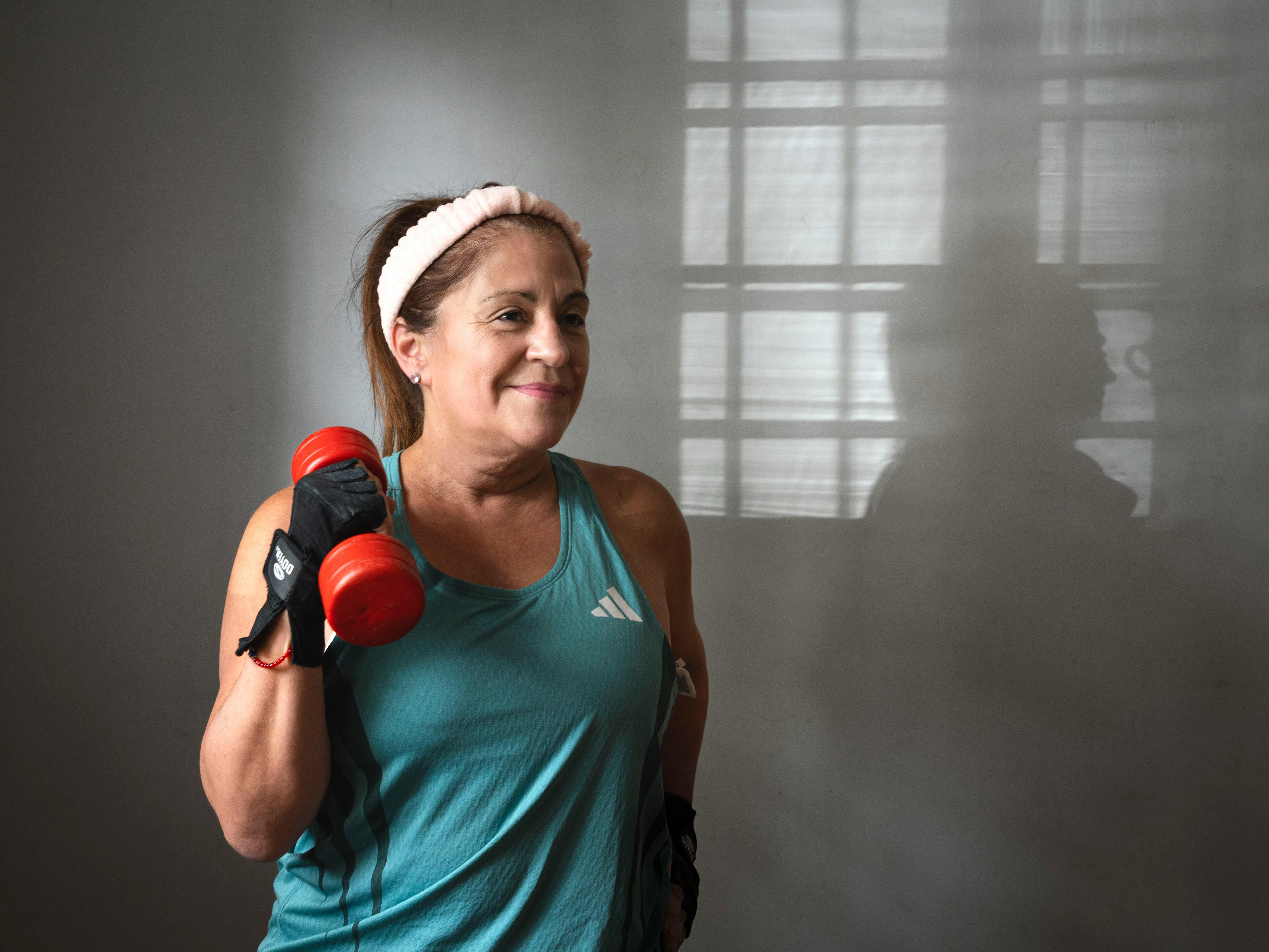
Which means, currently, the people most likely to catch sarcopenia early are exercise physiologists and physios. Tanya Sharma, who runs the women-only exercise physiology clinic Strength By Women in Longueville on Sydney’s lower north shore, sees women come through her door in their late 50s and 60s after a fall, or a niggling lower back, or a sense that something has shifted. She’ll do the chair-stand test and the grip strength test and a movement screen. Then she’ll write a programme that, in her experience, is mostly twice a week, all major muscle groups, gradually loaded. “If you don’t use it, you lose it” is how she puts it, which sounds like a poster on a personal trainer’s wall until you watch a 64-year-old work back up to a 12kg goblet squat over three months and realise she’s right.
The protein nobody is eating
The other half of the conversation is food, and this is the part that catches even women I’d consider extremely health-literate.
Older bodies need more protein, not less. The current intake recommendation for over-60s sits at roughly 1.2 grams of protein per kilogram of body weight, which means a 70kg woman wants something like 84 grams of protein every day if she wants to give her muscles something to do their work with. Most older Australians are running about 30% short, per dietitian Louise Murray, who also features in the Women’s Weekly story. Thirty per cent. That’s not a tweak.
I’ve watched my own mother, who eats beautifully, cook a piece of fish for dinner that’s about 110 grams raw and then have toast with jam for breakfast and a salad with a few cubes of feta for lunch and assume she’s covered. She isn’t. Even by her own ungenerous accounting, she’s eating maybe 45 grams a day.
I’m not going to write you a meal plan. There’s no shortage of those, most of them written for people training for half-marathons. The point is smaller. If you are over 50 and you are not eating something with proper protein in it at every meal, your kitchen is part of the problem. Two eggs is fifteen grams. A small tin of tuna is twenty. A cup of cottage cheese is twenty-five. A 150g chicken breast is forty. Stack three meals like that and you’re closer to the target. The supplement industry will sell you a tub if you want one, and if you don’t, you can get there with what’s already in the IGA.
The cost of waiting
The reason I’m writing this with my GP voice on rather than my magazine voice is that the data on intervention is not subtle. SBS reported on Deakin work years ago showing that women between 60 and 90 who ate lean red meat and did strength training built measurable muscle. Not maintained. Built. The same studies show that postmenopausal women returning from a period of inactivity, the kind of inactivity that follows a knee operation or a bad winter, can recover sarcopenia traits with structured exercise.
The Women’s Weekly piece closes on a small case study. Phillippa Harrington, 79, a Sydney grandmother, started one-on-one physio sessions and got measurably stronger. Seventy-nine. The thing the Deakin researchers say, in slightly more guarded academic language, is that no one is too old for the muscle to come back. The body keeps responding to the ask. The trick is to ask it.
The trick, also, is to ask it before the chain runs all the way through. Before the jar becomes the stair becomes the fall.
What I’d do tomorrow if I were 50
I’d find a GP and ask, specifically, for a Five Times Sit-to-Stand and a grip strength test. They might not do them. If they don’t, find one who will. Most exercise physiologists will run them on intake. Medicare rebates can apply if you have a referral.
I’d also do a quick honest audit of what I ate yesterday, by gram, and notice how short I came in.
And then I’d find two days in the week, the same two days every week, and put a reasonable resistance session in them. Not a class with a thumping soundtrack. Not the kind of regime that turns into a project and then collapses. Two sessions, six exercises, half an hour, repeated the following week.
I’m aware as I write all of this that it sounds simpler than it is. Habits are not flexible at 50, and especially not at 70. But the thing my grandmother would have wanted, if anyone had given her the language for it, is the small, dull, repeatable insurance policy that the body actually responds to. She didn’t get that. The current cohort of Australian women in their late 40s and 50s still can. The medical system isn’t going to bring it to them. The data, as best as Deakin and the MJA and the women’s-magazine health desks have been able to triangulate it, says you have to bring it to yourself.
Twenty years from now someone might write this same piece, and the screening will be standard, and the protein conversation will be ordinary, and the chair-stand test will be in the Medicare item list. We aren’t there. I’d rather get a head start.
I’m still working out where I sit on supplements and HMB and creatine, all of which keep coming up in this literature. That’s another column. For now, the simpler intervention seems to be the one most worth writing down.
Dr Mira Joshi
Brisbane-based GP turned health writer. Covers women's health, fertility and the gap between clinic and culture.