What clean performance wear is asking fashion to rebuild
Clean performance wear is forcing fashion to rethink stretch, waterproofing and the chemical shortcuts that made modern activewear feel effortless.
On a cold Sydney morning, the first thing I want from my clothes is not ethics. Obedience, if I am being honest. Leggings that pull on without a fight. A sports bra dry enough for the train home. A shell that can take a burst of rain over the harbour without turning clammy against my arms. Performance wear has trained us into that bargain. Stretch, recovery, sweat-wicking, weather resistance. Somehow they have started to feel less like engineering and more like manners.
So the new argument over clean performance wear feels more intimate than the usual sustainability pitch. It asks us to inspect the deal stitched into modern activewear, not merely pick the softer values language. In Vogue’s reported feature on less-toxic performance wear, Sophie Benson makes the point quietly: the miracle garment was never magic. Chemistry did the lifting. Coatings did too, along with mills, finishing processes and a set of compromises most shoppers were never meant to see.
Then the room gets less dreamy. A runner or pilates regular might only want to know whether the tights will still hold their shape after a few hard washes. Compliance teams read the same wardrobe another way. In bluesign’s 2026 guide to PFAS in clothing, the question is evidence: which chemicals sit in the finish, which tests back a “PFAS-free” claim, which bans are now moving from abstract environmental worry into manufacturing deadlines. Activewear has always sold trust. Close to the skin, we wear it. We sweat in it. Sometimes for hours, we leave it there.
The fabric remembers
The builder’s view is not glamorous. It may be the most useful one. Listen to the people trying to replace elastane and fluorinated finishes and the language turns technical almost immediately. Stretch percentages. Recovery. Washability. Industrial spinning lines. To my ear, it sounds less like a mood board than a lab bench, which is exactly the point.

What snagged me in the Vogue piece was the size of the performance gap. Conventional synthetic elastane can stretch by about 500 per cent. Tera Mira, one of the companies trying to build a bio-based alternative, is working in the 50 to 100 per cent range. That is not a rounding error. It is the distance between a garment that behaves the way the market expects and one still learning how to move.
In Vogue’s reporting, Tera Mira co-founder Jeanne Bégon-Lours sounds less like a founder selling salvation than someone describing a long industrial slog.
“We’ve got a lot of inbound interest from underwear and sportswear brands”
Jeanne Bégon-Lours, via Vogue
A lot sits inside that small sentence. Interest is there. Impatience as well. Scale, though, is another matter. Proof is another after that. One question hanging over cleaner activewear is whether the supply chain can be de-risked without drifting back towards the fossil inputs and chemical shortcuts the category is trying to leave behind. For now, the answer seems to be: not neatly. Not yet.
I do not read that as bad news. Better that, really, than the polished language fashion usually prefers. We have spent years being sold sustainability as if it were a finish you could spray on at the end of a product cycle. This version is messier. Less-toxic performance wear is a chemistry problem before it is a branding one, and chemistry refuses the clean lines of a campaign deck.
The rules are getting closer to the wardrobe
Regulation lands like a cold cloth on all the dreamy talk about innovation. Once PFAS bans and disclosure standards harden, the question is no longer whether a brand would like to sound cleaner. It is whether it can substantiate the sentence on the tag.
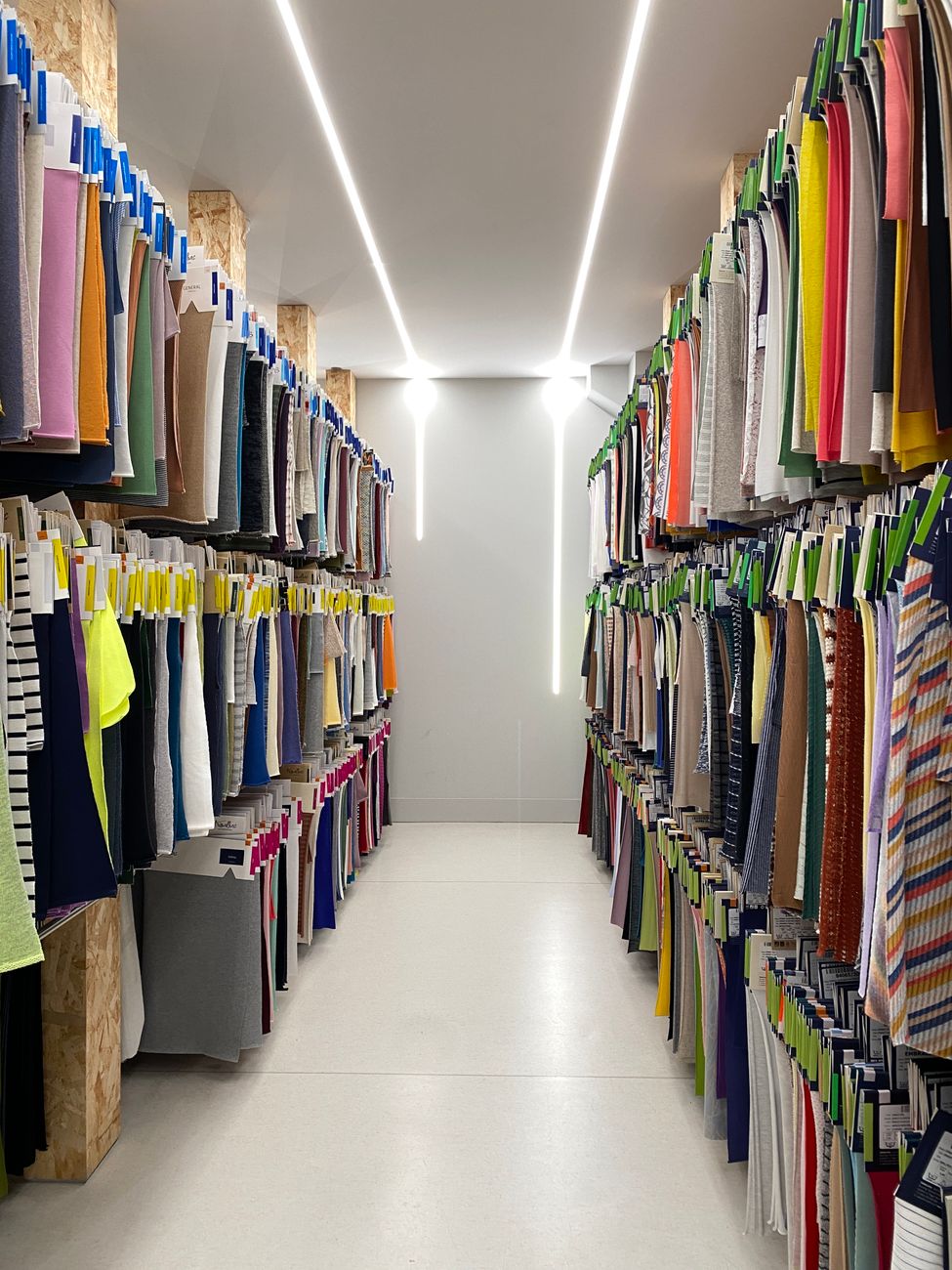
A credible PFAS-free claim, as bluesign lays out, means tracing coatings and finishes, understanding where intentionally added fluorinated chemicals have been used, and recognising that “waterproof” or “stain-resistant” has often been shorthand for a complicated chemical history. The least romantic answer is the most useful one: documentation, supplier discipline and testing.
That is what makes this story more interesting to me than the average ethical-fashion cycle. We are watching the industry lose the luxury of vagueness. Activewear was built on hidden assistance. Stretch that snaps back. Rain that beads and slides off. Fabrics that feel dry sooner than they should. Once regulators begin asking what made those sensations possible, fashion has to translate desire into process. Awkward work.
There is a wellness contradiction here too. The category talks in the language of self-care, clean living and healthy routines, yet it has often relied on material systems kept carefully out of sight. In Australia, where athleisure long ago stopped pretending it was only for the gym, that contradiction sits close to the body. School drop-off in leggings. Airport outfits in technical layers. A coffee run in a jacket designed, somewhere upstream, to handle weather. The chemistry question no longer stays politely in the factory.
The honest brands sound a little less perfect
The part of this shift I trust most is the loss of purity language. When brands or suppliers describe partial gains instead of total reinvention, the prose becomes less seductive and more believable.
Armedangels, for instance, has been testing a near-plastic-free windbreaker that still reaches a 97 per cent wind-proof rating. I like the dullness of that number. It tells you there is still a trade-off in the room. So does the company’s candour. In Vogue’s piece, Julia Kirschner, Armedangels’ director of impact and innovation, puts it plainly:
“We said we wanted to be 100% plastic-free, which we didn’t achieve, and that’s how we are communicating it”
Julia Kirschner, via Vogue
Better than any slogan, that sentence admits the category’s real problem. Performance wear rarely fails on aspiration. It fails when aspiration starts over-claiming.
Hyosung TNC’s bio-based spandex work has the same tension. The company says it has reached 70 per cent bio-based content, backed by a reported US$1 billion transition investment and plans for a Vietnam facility with 50,000 tonnes of annual capacity. Serious numbers. Still, the language worth trusting is the language that leaves room for incompletion. As Vogue reports, Hyosung’s Simon Whitmarsh-Knight is careful not to pretend the fibre is something it is not.
“We can’t call it 100% natural. We’re working to get it to 100% in the future, but [in the meantime] we’re very careful about how we’re presenting it.”
Simon Whitmarsh-Knight, via Vogue
Wearers need that honesty too. In a recent Guardian Life test of lower-impact sportswear, the useful details are physical rather than moral: how pieces feel after movement, what they do in heat, whether the compromise still feels worth making. Wirecutter’s reporting on summer tank tops gets to a similar truth from another angle. People do not keep wearing a garment because its fibre story is righteous. They keep wearing it because the cut, hand-feel and recovery work on an ordinary Tuesday.
So what trade-offs will users accept? Some, clearly. A different hand-feel. A little less snap. More care with washing. Maybe a narrower definition of technical. Failure is another thing. A legging that bags out by lunch, or a shell that gives up at the first bit of drizzle, will not be rescued by a cleaner hangtag. The clean-fashion dream gets real the moment it has to survive friction.
Clean beauty was the rehearsal, not the template
Fashion is tempted to say it is borrowing the clean-beauty playbook and arriving late. Up to a point, sure. The vocabulary overlaps: ingredient scrutiny, hormone concerns, safer alternatives, sceptical customers. Clothes make the argument harder because garments are not jars on a bathroom shelf. They are stretch, odour, abrasion, heat, laundering, weather and skin contact, all at once.
In Vogue’s earlier analysis of refillable beauty, the problem was that even attractive sustainability ideas stalled once convenience, infrastructure and habit pushed back. That feels like a warning for fashion now. Good intentions are thin protection when the product has to perform through sweat and repeated washing. The analyst’s question is whether the category can make cleaner function feel normal enough that shoppers do not register it as sacrifice every time they get dressed.
History gives the materials story a little perspective. In May, Fast Company reported on a US$34 million bet to replace cotton and polyester, another sign that textile innovation has moved from niche science story into investor logic. That does not guarantee a clean outcome. It does suggest the materials question is no longer peripheral. Mills, chemical suppliers and brands seem to understand that the old performance story has started to look expensive, opaque and brittle under scrutiny.
Back to the wardrobe, then. For years, activewear sold a fantasy of effortlessness: the miraculous legging, the featherweight shell, the top that behaves through heat and salt and repeated washing without asking what it took to become that way. Clean performance wear breaks the spell a bit. It asks us to look at the seams, the finish, the fibre content, the factory timeline and the compromise hidden inside the phrase high performance.
I am not convinced shoppers need perfect purity to respond to that. Honesty may be enough. A garment that tells the truth about what it can do, what it cannot yet do, and what had to change to get even this far might feel less glamorous than the old promise. More modern, too. If fashion wants to rebuild trust, that may be the piece worth engineering first.

The Lifestyle Desires brief
Style, food, travel and wellbeing — weekly in your inbox.
Subscribe