What a room reveals when every chair is trying a little harder than comfort
Melbourne Design Week's 100 Chairs brings together 130+ Australian designers rethinking the humble seat, and local craft is finally telling its own stories.
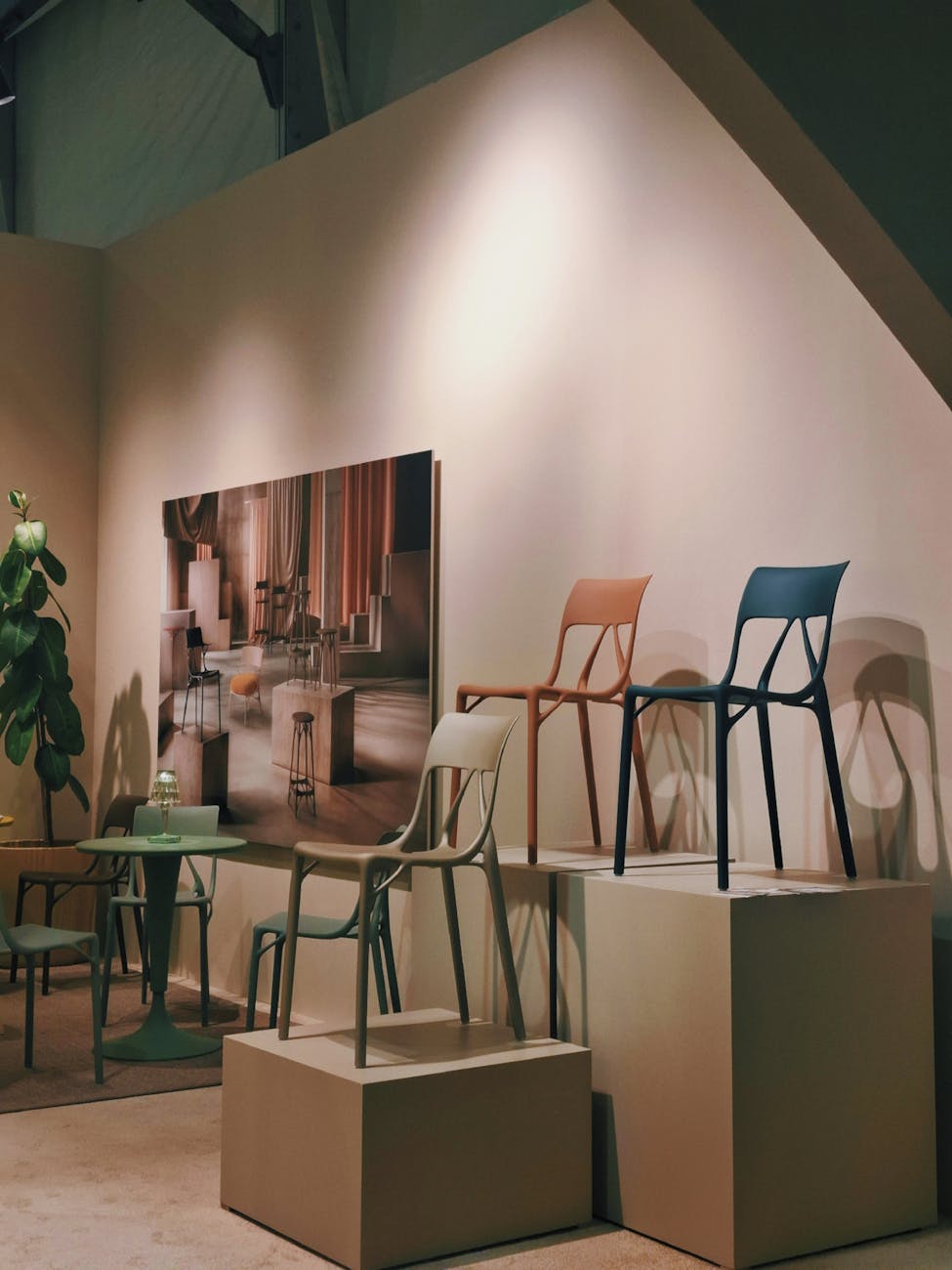
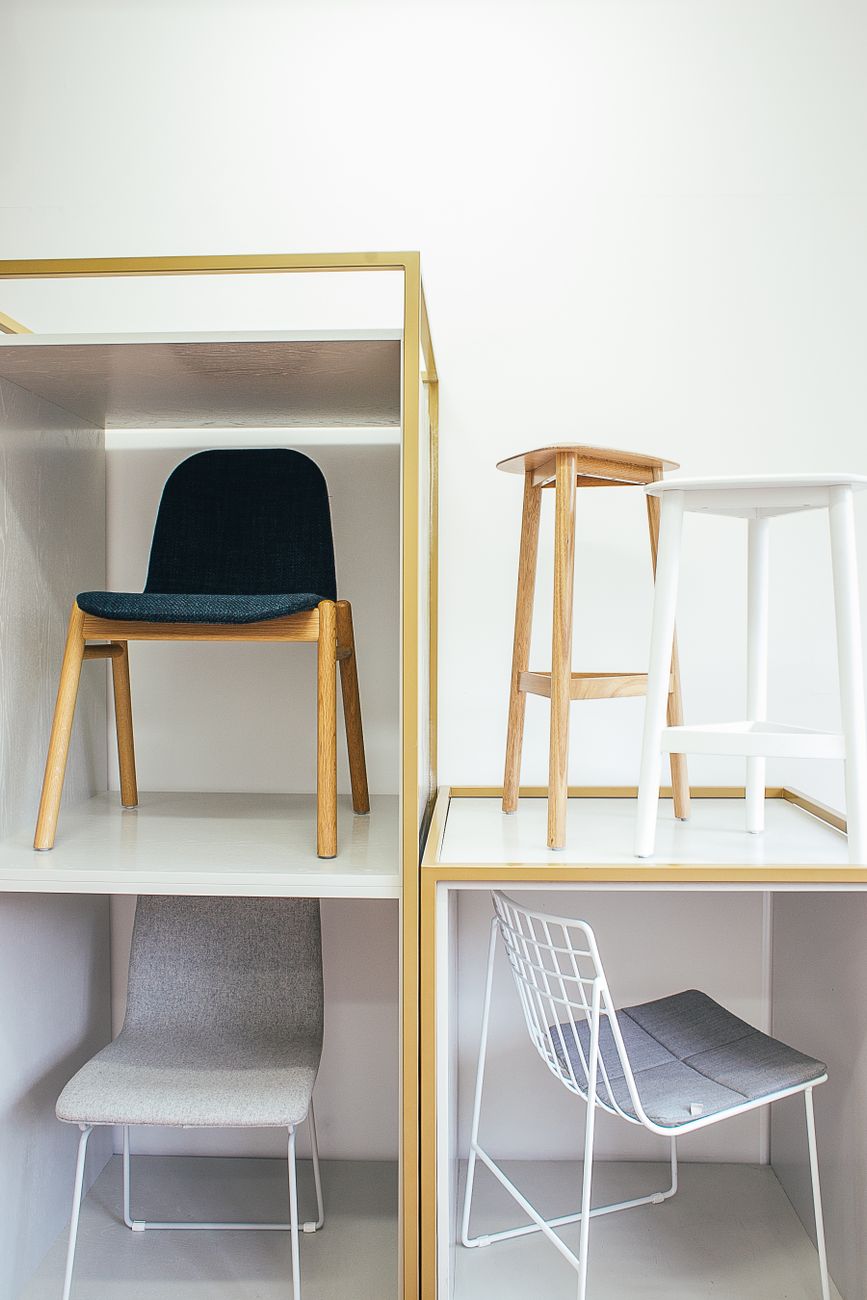
I’m standing in the South Magdalen Laundry at Abbotsford Convent on a grey Wednesday afternoon, and the room is full of chairs that are not quite behaving themselves. There are handlebars where armrests should be. There is a seat made from a steel grid that looks like it was stolen from a loading dock and reupholstered with a single cushion the colour of butter. There is a chair wrapped in bright yellow fur, part Bauhaus, part Sesame Street. A blue velvet number nearby has been embroidered with flowers and finished with a frilled backrest, the sort of chair that would have made Marie Antoinette pause and say, bit much. A chair made from inflatable ripstop nylon: a hiking chair that wandered into a design exhibition and decided to stay.
The laundry itself is doing half the work. Nineteenth-century bluestone, high timber ceilings, light falling through tall windows in that particular Melbourne way (grey then gold then grey again, like the weather can’t make up its mind). Someone has hung a series of woven pendant lights above the chairs, and the effect is less gallery, more unusually ambitious share-house.

None of them are apologising.
This is 100 Chairs, the largest survey of Australian furniture design ever staged. One hundred and thirty designers, architects, artists and makers (a number the co-curators Dale Hardiman and Tom Skeehan of Friends & Associates are still a little awed by) each invited to contribute one chair, on one condition. It had to be designed in Australia and made in Australia. No exceptions.
The brief sounds simple. In practice it meant a lot of promising sketches died at the costing stage. Hardiman told the Canberra Times that the competitive ratio shifted from around 90 per cent accepted in 2025 to roughly half that this year. Not because the ideas weren’t good, but because finding a local metalworker or timber mill who could realise the thing at a budget that didn’t require a second mortgage turned out to be the real design problem. The constraint is also the point. Every chair in this room is proof that someone, somewhere in Australia, can still make it.
The exhibition is the fourteenth for Friends & Associates since 2017, and it lands inside a Melbourne Design Week that has swollen to more than 400 events across Victoria. The festival is ten years old. NGV director Tony Ellwood, who spoke at the launch, seemed almost surprised by the thing he’d helped build.
We had no idea that in ten years the festival would grow to such a scale, and become one of the integral parts of the fabric of the Australian design community.
— Tony Ellwood, NGV director, via The Canberra Times
That fabric now counts 2,600 events staged over the decade and more than a hundred pieces acquired for the NGV’s permanent collection. I don’t think anyone’s saying Melbourne has caught up with Milan, but it’s stopped asking permission. The conversation is its own now.
I walked the room for an hour and the chairs told me more than the press release did. Less Scandinavian deference. More material honesty. A willingness to let a chair be funny or difficult, sometimes both at once.
Sandra Githinji’s TURN, sitting low to the ground on legs cut from reclaimed meranti timber, is the chair I keep coming back to. The timber was salvaged from balustrade posts pulled out of a suburban Melbourne house (Githinji has described the process as a kind of material archaeology) and the form draws from Kikuyu seating culture, low stools designed for conversation rather than posture. The result is a chair that holds two continents in its joinery. It’s not trying to look like anything you’ve seen in a Scandinavian catalogue, and it’s better for it.
Across the room, Barnabas Dean’s FFF#1 pairs automotive-grade steel tubing with soft yellow fur. Industrial and infantile in the same object, as if a welding bay and a nursery had a brief and unhappy affair. Makushla Harper’s Windsock is a portable inflatable chair made from ripstop nylon, designed for hikers and campers, that you could carry in a daypack. The range of answers to the same simple question (what do you sit on?) is almost disorienting.
The thing that holds the exhibition together is the tension between art object and furniture. Some of these chairs plainly do not want you to sit down.

Chan Hung Hin’s Steer is built from bicycle handlebars (chromed, curved, aggressive) and looking at it from across the room I felt the same small adrenaline hit I get when a magpie locks eyes with me on a spring footpath. It’s a brilliant piece of sculpture. I wouldn’t want it in my kitchen.
Then there’s Adam Goodrum, probably Australia’s most internationally recognised furniture designer, whose Re-Stitch Low Chair sits quietly among the louder provocations. The latest evolution of his Cappellini-produced Stitch series, it folds flat, assembles without tools, and carries the kind of considered ergonomics that says the designer has actually watched someone sit down and stay there for a while.
I think the appeal of the hinge series has always come from the balance between functionality and surprise.
— Adam Goodrum, via The Guardian
Goodrum’s chair costs north of several thousand dollars. Other pieces in the exhibition are priced at up to $25,000. Hardiman’s line about this (if you buy it, you can sit in it) is delivered with a shrug, but it hides a genuine question about who the market for this work actually is. Are these chairs for living rooms, or are they for collections? The answer, I suspect, is both, but the ratio depends on which chair you’re looking at. The collector who buys a Githinji is buying a migration story as much as a seat; the person who orders a Windsock just wants something that won’t break their back on the Overland Track.

The week before 100 Chairs opened, Joanne Odisho won the 2026 Australian Furniture Design Award for Mod-u, a modular lighting system made from eggshell composites and bio-filament. Waste-stream materials collected from local Melbourne cafes and converted into something you’d genuinely want above your dining table. The AFDA brief this year, “Living Well Living Small,” explicitly asked designers to consider compact spaces and sustainable materials. Odisho’s win and the 100 Chairs exhibition are not the same story, but they share a premise: Australian design in 2026 is increasingly interested in what things are made of and where, and less interested in whether it photographs well on a white background for an international catalogue.
After an hour with 130 chairs that are all trying, in their various ways, to be something more than a place to sit, the room starts to feel like an argument, not a showroom. Ash Allen’s Double Pillow chair made me laugh: two cushioned forms pressing into each other through a steel mesh cage, a joke about domestic softness that lands. Some of the price tags made me quietly furious. And Githinji’s TURN made me think about where timber comes from and what it remembers. Not a bad spread of reactions for a furniture show.
I had this idea of creating volume with steel mesh and having two pillows touching each other, which is a recognisable form, referencing classic upholstered foam furniture.
— Ash Allen, via The Canberra Times
The exhibition runs until 24 May at the Abbotsford Convent. Free, open to the public. When I walked out into the late-afternoon light, the thing I kept thinking about wasn’t any individual chair. It was the collective statement. A room full of Australian designers who have stopped trying to look like they’re from somewhere else. A room where the materials have names and postcodes. A room where every chair is trying a little harder than comfort, and most of them are succeeding at something more interesting.

The Lifestyle Desires brief
Style, food, travel and wellbeing — weekly in your inbox.
Subscribe