Why men's grooming has started to exhale
The sharp fade is not dead, but 2026's most interesting men's grooming mood looks softer, greyer and much less determined to prove anything.
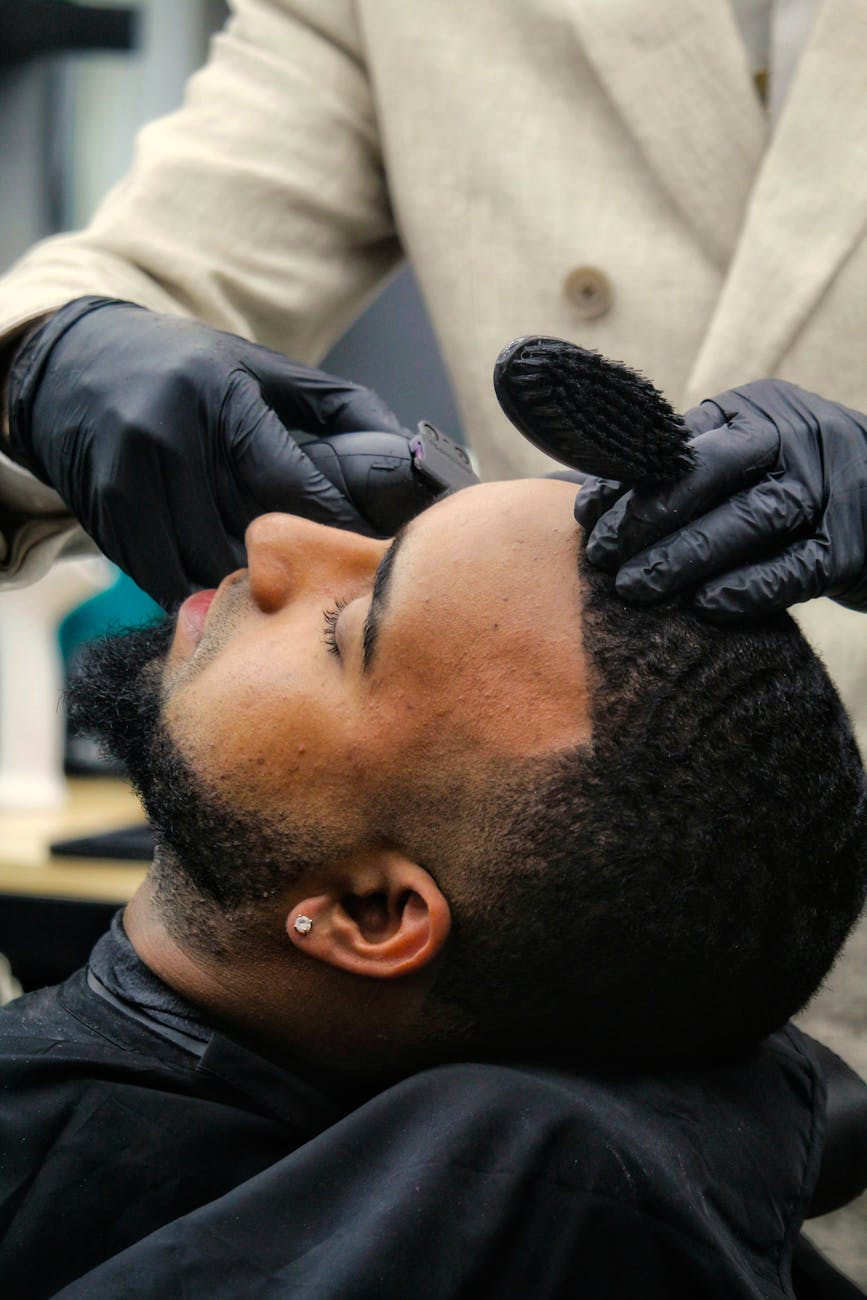
There is something oddly intimate about walking into a barber and asking for a haircut by someone else’s first name. The cape clicks shut at the neck. The mirror catches the fluorescent strip overhead. Fine dark clippings gather around the chair base like pencil shavings. Somebody asks for “The Jacob” and everybody in the room seems to understand that this is not really about Jacob Elordi at all. What it is about is a feeling — a fringe that falls instead of standing to attention, a beard edge that looks handled rather than drawn on with a ruler, a face that suggests the person attached to it has been outside, slept badly once or twice, laughed at dinner. Lived. Men’s grooming pieces so often arrive with the language of control. This one doesn’t. What caught my attention is the release in it: the most current version of looking good now carries a little air.
I kept turning over a line from Stephanie Darling’s recent Sydney Morning Herald feature on the season’s men’s hair shift. Darling put the whole thing plainly: “Two words best summarise the key trends in men’s hairstyles this season: loose and relaxed.” An entire aesthetic era, you can hear it ending in that sentence. For years, the dominant fantasy in men’s grooming was effort disguised as ease. The skin had to look untroubled. The fade had to be exact. The beard had to stop and start in mathematically reassuring places. Even “natural” was usually a high-maintenance performance. What Darling describes — and what Australian barbers seem to be seeing, chair by chair — is a slight but meaningful loosening. The look is still considered. Nobody is arguing for neglect. But the insistence on visible precision has eased.
Jacob Elordi as shorthand makes sense in a way most celebrity grooming references don’t. He is not the only man with wavy hair and a good jawline, and God knows these references are usually less profound than the people passing them around would like to believe. Still, Elordi’s appeal as a style prompt is specific: hair that rarely looks shellacked into obedience, that has bend in it, space, a bit of collapse at the right moment.
Even when he is dressed expensively, the head attached to the clothes often seems unbothered. That matters, because men’s grooming icons have long tended to signal mastery. David Beckham, another evergreen reference point in the Herald piece, always represented polish you could study from three angles. Elordi suggests a different aspiration. Edited, but only lightly. The point is not to appear unfinished. You want to leave some evidence of the person in place.
This is where Sydney barber Heather Bickerton becomes more interesting to me than the celebrity itself. The same report notes she has spent 25 years cutting men’s hair — long enough to watch several cycles of masculine vanity arrive dressed up as practicality. Her read on the present moment is concise: men are asking for “more tailored, wearable waves and less sharp fades”. Because it is a direct quote, I am happy to leave the comparative structure intact. It tells you how the shift is being phrased inside barber chairs.
What lingers is the word wearable. Beauty language, not battlefield language. A style that can survive the train home, the office lift, a late beer, the weather turning sticky. Movement. It also suggests that the best grooming now has to live with a body rather than sit on top of it like a hard hat.
The beard conversation is changing in the same direction. In GQ’s 2026 grooming forecast, Dean Banowetz argues that “Allowing natural gray hair to show is one of the most confident trends of 2026”. I like that he chose confident. Not youthful. Not rugged. Confident. That tells on the whole emotional mechanics of the thing. A beard showing silver, or a hairline nobody is fighting to the death every morning, communicates something calmer than the last decade’s hyper-managed masculinity. The job is no longer to eliminate every sign of time, softness or irregularity. The job is to look like yourself on a very good day.
Vanity is still in the room — grooming never stops being vanity. But it is a vanity with fewer fluorescent warning lights attached.
Optimisation, correction, upgrade — anyone who has spent time around beauty marketing can hear the old machinery humming in the background. And that is why the quieter details in the reporting matter. The Men’s Health wash guide notes that most men do well washing their hair two to three times a week, not incessantly, and the Herald piece points out that topical treatments may take three months to show results. Neither fact is especially glamorous. Both are useful. More than that, they describe a grooming culture built on patience rather than instant engineering. Texture tends to look better when it has not been scrubbed into submission. Hair health improves on the timeline of biology, not the timeline of a product launch. Once you accept that, a looser haircut starts to look like more than an aesthetic preference. It starts to look honest.
Not a sexy grooming promise, patience. It does not photograph well and it cannot be packaged as a before-and-after miracle. Which may be exactly why it feels current. The mood now is suspicious of anything that announces itself too loudly — a jawline traced into high definition, a serum claiming to reinvent your scalp by Friday.
Across fashion and beauty, the old luxury codes of perfection have been tiring people out for a while. I think that is the deeper reason this trend has landed now. The fantasy of frictionless wealth, frictionless skin, frictionless living arrives at ordinary Australian life already dead. Most people do not move through the week in climate-controlled serenity. They commute. They sweat. They eat lunch at their desks. They pull on a knit, take it off, stand in coastal wind, walk from hot pavement into over-air-conditioned shops. Grooming that acknowledges all that feels more contemporary than anything too lacquered. The mood shift is cultural before it is technical. The cut matters. The bigger thing is the appetite for evidence that a life has actually been lived inside the style.
The emotional tone of barbering shifts with it. The sharp fade is not disappearing. Nor should it. There will always be men who want crisp geometry around the ears because crisp geometry makes them feel pulled together — nothing shallow about that. Still, a softer grooming ideal broadens the field. It gives men permission to approach beauty without pretending they are above beauty. Maintenance can be discussed as maintenance, not as some stoic refusal to care while somehow emerging perfectly lined up.
If I sound overly invested, it is because beauty culture runs on these little theatre tricks, and they exhaust everybody eventually.
There is a practical tenderness in this as well. A face can be looked after without being policed. A beard can be shaped without being marched into formation. Once you notice the difference, the old style of hyper-definition starts to look slightly anxious — as if the grooming is doing emotional labour the man himself no longer wants to perform.
What I keep coming back to is how small the visible adjustment really is. A touch more length. A beard line left slightly gentler. Grey left alone for once. Hair that seems to have been dried by air and hand rather than by a campaign strategy. Tiny things. Style nearly always moves this way, though. First the surface changes by a few millimetres. Then the values underneath become legible. A haircut stops being just a haircut. It becomes a record of what kind of effort a culture still admires, and what kind has started to look a bit desperate.
I might be romanticising the whole business. Trend writing is prone to grand claims, and barbershop language can acquire meaning very quickly once it leaves the chair. Even so, there is something persuasive in the convergence of those three source notes: the Sydney call for looseness, the GQ confidence in grey, the Men’s Health reminder that healthy hair responds badly to panic. Put together, they describe a grooming mood that has stopped treating every strand as a problem to solve. That feels timely. It also feels adult.
Men’s grooming in 2026 still wants shape, good products and a decent mirror. It just no longer looks quite so desperate to prove that effort happened. The best version of the trend leaves room for softness, age, texture, the ordinary mess of having a face. You can see why that would appeal. After years of edges so clean they looked almost theoretical, a little human imprecision reads as luxury of another sort. Not carelessness. Ease you can actually wear.
The Lifestyle Desires brief
Style, food, travel and wellbeing — weekly in your inbox.
Subscribe