When Sydney's grand old sandstone loosened up
The Lands by Capella is more than a heritage rescue. It offers a glamorous, usable model for how older Australian buildings keep dignity and gain a pulse.
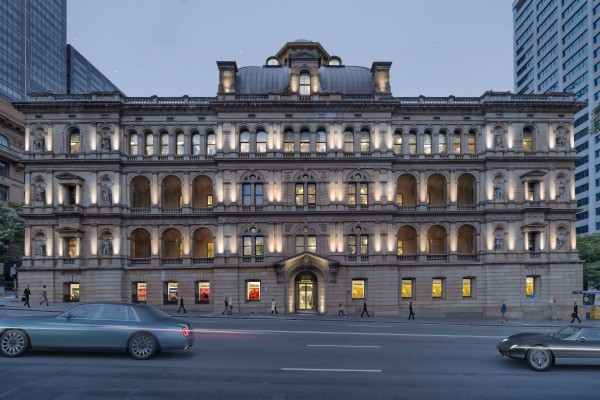
There is a kind of Sydney sandstone that seems to expect silence. It stands at 22–33 Bridge Street with the old Department of Lands’ stern good looks intact, all carved confidence and civic posture, and for years the promise on the outside wasn’t really matched by the chopped-up life within. The Guardian’s report on the building’s rescue remembers it as a grandeur dulled by drab partitions. Now, recast as The Lands by Capella, it’s become the sort of address that can hold a dinner, a launch, a fashion crowd, a different idea of Sydney. I keep returning to that shift because it feels larger than one redevelopment. It feels like a clue.
A lot of adaptive reuse gets sold to us as virtue. Recycle the bones. Save the façade. Be grateful the wrecking ball didn’t arrive. All true, and still a bit bloodless. What interests me here is the appetite for glamour. Not tackiness. Not the fake-luxury trick of sanding history down until every room looks like an airport lounge.
Something harder.
A building that keeps its manners, keeps its stone, keeps its memory of government and paperwork and empire, then allows contemporary life to move through it without apologising for being contemporary.
Maybe that’s why the heritage praise matters less to me as a trophy than as a description of temperament. The National Trust of Australia (NSW) judges said the project “respectfully preserves the building’s grand sandstone façade and intricate heritage interiors, while carefully introducing contemporary architectural elements that sympathetically speak to its rich past”. Normally I’d flinch at the formal language of awards citations. But here the sentence gets at the central trick. Respect is only convincing when it doesn’t turn a building into a relic behind velvet rope.
The building sat unused from 2016 until this redevelopment reopened its doors. The scale of what was unlocked isn’t minor: Hassell’s project page puts it at 10,265 square metres of new amenity. Numbers like that can sound a little corporate, yet in design terms they point to something human. Rooms that had gone dim get looked at again. Circulation changes. Thresholds become part of the experience rather than dead space between one compulsory function and the next. If you care about interiors, even privately, you know this sensation. A floor plan begins to breathe once somebody stops fighting it.
That matters.
That, to me, is the most persuasive line in the whole story. Dakota Bennett told Indesignlive that “the building’s existing rooms, their proportions, their hierarchy, their relationship to light, are used to determine what happens where.” I love the plainness of that. No swagger. No claim that the new scheme imposed genius on an inert shell. Just an admission that old buildings come with instructions if you’re patient enough to read them. Any decent home renovator knows the same thing. The house usually tells on you. Ignore the window line, force the kitchen into the wrong end of the plan, flatten every room into one endless open rectangle, and sooner or later the place sulks.
The former Department of Lands building is, obviously, not a Federation bungalow in the inner west. Its construction stretches back to the late nineteenth century, and its scale is civic rather than domestic. Still, the lesson travels. Australian design has spent the past decade trying to work out how much reverence is enough. We’ve had the museum version, where heritage means don’t touch anything interesting. We’ve had the developer version, where one photogenic façade is kept upright while everything behind it is treated as disposable. Neither approach feels especially adult now.
What this project suggests instead is a more seductive compromise. Hold on to the things that give a place its authority, the stone, the internal grandeur, the sense of procession, then introduce present-day uses that bring bodies, noise and money back into the frame. That may sound unromantic. Money usually does. But empty heritage isn’t morally superior to occupied heritage. An unused landmark is still a form of loss. When Tracey Skovronek said on Purcell Architecture’s project page that restoring the historic character of The Lands was about honouring the building’s legacy while securing its future, the phrase that matters is securing its future. Old buildings don’t survive on admiration alone.
I don’t mean that every old building should be turned into a luxury playground. Sometimes a school should stay a school, an office should stay public, a station should keep serving commuters instead of cocktails. But this site had already slipped into the dangerous category of admired from the pavement and underused in practice. In that condition, purity can become a kind of vanity. The question stops being whether change is acceptable and starts becoming what sort of change can keep the original dignity intact. That’s a more interesting, and more difficult, design brief.
I suspect this is what people are responding to right now, even if they wouldn’t put it in architecture-school language. We’re tired of spaces that feel frictionless and placeless. The all-beige apartment lobby. The hotel bar that could be in Barangaroo, Brisbane or Abu Dhabi, who can tell. In that context, a big sandstone building on Bridge Street becoming more itself, not less, is oddly moving.
Atmosphere isn’t usually added at the end by a stylist. It’s stored in fabric, ceiling height, shadow, the little drama of moving from street to stair to room.
There’s also something distinctly Sydney about this kind of rescue. The city has always had a weakness for surfaces that photograph well: harbour blue, brass rail, expensive glass, a terrace lit properly at dusk. Sometimes that weakness produces fluff. Sometimes, when the building is good enough, it produces a better outcome than purism would. The old Department of Lands building was never going to become lovable again through worthy restraint alone. It needed an audience. It needed a reason for people to cross the threshold. A hospitality and events precinct, for all the faintly grim language of precinct, turns out to be one very effective reason.
I’m less convinced by the tendency to frame these projects as clean moral victories. Adaptive reuse always involves compromise. Services have to go somewhere. Access changes things. New uses alter the social meaning of a place. A building once organised around bureaucracy and state power now hosts leisure, spectacle and private spending. That’s not neutral. But it’s honest about how cities work. If anything, the frankness is refreshing. Better to admit that heritage survives through use, taste and capital than to pretend it floats above them.
Cities are rarely pure.
One reason the project travels beyond the architecture set is that sandstone still does emotional work in Australia. It signals endurance, money, weather, the slower pace of craft. In lesser hands that symbolism can harden into heritage cosplay. Here, at least from the evidence the designers have offered, the point wasn’t to embalm the past but to let those surfaces do what good materials always do: carry time without becoming precious about it.
For home readers, and I think this is where the story becomes more than a one-off Sydney curiosity, the useful part isn’t the budget or the pedigree of the firms involved. It’s the design attitude. Hassell and Purcell Architecture seem to have understood that the old rooms already contained a logic. Proportions. Hierarchy. Light. Those aren’t heritage-only concerns. They’re the same quiet principles that make a weatherboard house feel calm after a good renovation, or a worn terrace finally feel generous once somebody stops filling every corner with intention.
I keep thinking about the phrase haute couture host from that Guardian piece because it’s slightly outrageous and also exactly right. The best adaptive reuse doesn’t only preserve. It dresses the building for the life it’s about to lead.
Not with costume jewellery.
With confidence. With enough editing to let the original face show through. In fashion, in interiors, in cities, the hardest thing is often resisting the panic to over-explain. You don’t need to shout when the cut is this strong.
Perhaps that’s why this particular redevelopment lands so cleanly as a lifestyle story rather than a niche heritage one. It sits at the intersection Australians increasingly care about: old materials, new ritual, public beauty, private desire. I might be wrong about this. Yet the popularity of homes, hotels and restaurants that keep some scratch, grain or civic heft suggests we’re past the era of wanting everything polished into anonymity.
What The Lands offers isn’t a sermon about conservation. It’s a more usable blueprint. Let the building keep its authority. Read the rooms before you redraw them. Treat light as structure, not garnish. Accept that glamour can be part of preservation if it’s grounded in the existing bones. On Bridge Street, that idea seems to have found its grandest possible expression. And for anyone who cares about how older places might keep living in Australia, that’s a rather lovely thing to see.

The Lifestyle Desires brief
Style, food, travel and wellbeing — weekly in your inbox.
Subscribe