A month on a vibration plate, and the limits of hype
Vibration plate benefits looked modest in a month-long trial: steadier routine, less soreness, and plenty of doubt around the fat-loss pitch.
A vibration plate seduces partly through architecture. It doesn’t ask you to redesign your life. Just find a spare rectangle of floor between the sofa and the bookshelf, a slab barely bigger than a bathroom scale, and stand there. Ten minutes. Lymphatic drainage, stronger bones, easier recovery, better circulation, toned legs. Maybe even weight loss, if you believe the box.
I understand why that pitch lands. A lot of wellness products fail on admin long before they fail on evidence, and in Maria Goldbach’s month-long Vogue diary the ritual was brief enough to become ordinary. That ordinariness turned out to be more interesting than the marketing: less soreness, a little more circulation, and the odd satisfaction of doing one small bodily thing every day.
Still, the sceptic in me reads the same machine from the opposite end — and I suspect most clinicians would too. When a gadget claims everything, the evidence is usually being stretched thinner than the product copy admits. The SELF experiment with experts in the room matters because it refuses the fantasy outcome. It treats whole-body vibration as something that might make certain movements feel harder, or help some people tolerate short bouts of exercise. Not as a magic method for melting fat. That distinction is doing a lot of work.
That tension is what makes vibration plates worth writing about. Not because the machine changes everything — it doesn’t — but because it captures a very particular kind of hope: something compact, expensive and slightly futuristic that seems willing to stand in for the slower work of strength, walking, sleep, rehab, patience. I might be wrong. But the plate feels most revealing as a story about our appetite for efficient care.
The machine in the corner
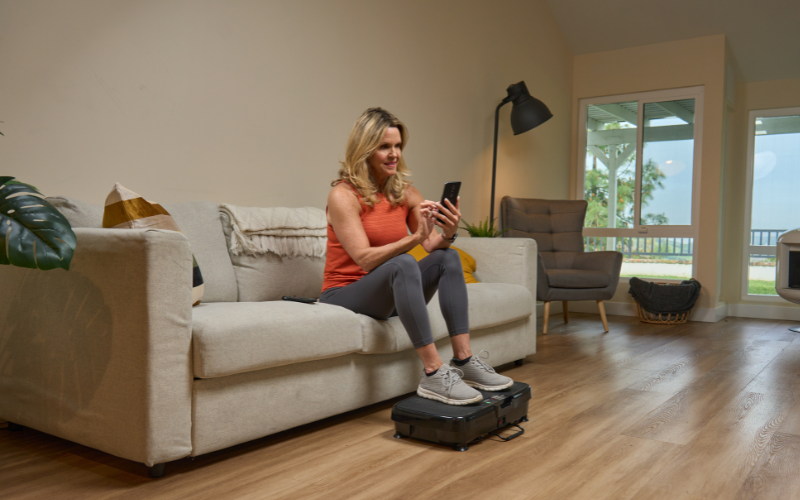
What Goldbach’s experiment gets right is the domestic reality of the thing. In most homes a vibration plate is not a glossy clinic treatment. It is a slab in the lounge room that hums, rattles the water on the coffee table, and makes the body feel, for ten minutes, as if every muscle has been lightly interrupted.

Practically, that smallness matters. The user-affected perspective in this story is not really about transformation so much as adherence. A bounded habit is easier to keep than an idealised one. Ten minutes can survive a messy week, and a machine you step on before the kettle boils has a different psychological profile from a gym programme that asks you to become a new person.
In Goldbach’s Vogue piece, the language around lymphatic support is where anecdote meets mechanism — and the gap between the two is where most vibration-plate salesmanship lives.
“The lymphatic system is a silent but incredibly important system in the body—a bit like the body’s waste disposal system.”
— Sigrid Ilumaa, Vogue
The quote lands because it translates physiology into household language. But “supports movement” and “flushes toxins” are not the same sentence, however often wellness marketing likes to blur them. I’ve seen this move before — a plausible biological mechanism stretched to cover a much bigger claim.
More convincing is Ilumaa’s second point in that same Vogue report: “it’s about activation, not exhaustion.” That feels closer to the truth. Not punishment, not a miracle. Just a stimulus that may sometimes prove useful.
What the body might hear
Plates are often sold as if vibration itself were the treatment, full stop. Bodies are fussier than that. Frequency matters. Posture matters. Whether you are simply standing there with locked knees or using the plate as a slightly destabilised surface for calf raises, squats or balance work matters too.

One detail from Goldbach’s month stayed with me: Ilumaa suggested keeping lymphatic-focused sessions at or below 30 Hertz. That is the loveliest corrective to the more-is-more instinct. The body is not a blender. Turning the dial higher is not automatically better care — only more sensation.
Meanwhile, the insider perspective in the research bundle, shaped through expert commentary in SELF, is much less dreamy than the advertisements. A physiotherapy-minded reading treats whole-body vibration as a supplement to movement, not a replacement for it. If you are already strength training, rebuilding confidence after injury, or looking for a low-friction way to wake up the lower body, a plate may have a role. Buy one because the internet implied it can do your exercise for you, and disappointment is almost built into the transaction.
Some bodies also find vibration unpleasant. Teeth chatter, ankles feel strange, balance can tip from mildly challenged to plain unnerving. The sensation itself is never a synonym for benefit. As with most home wellness equipment, tolerance becomes part of the data.
That is why the best case for a vibration plate is surprisingly unglamorous. Perhaps it helps you do heel drops while the pasta water comes up. Perhaps it cues a brief moment of movement between laptop hours. Perhaps it leaves your calves feeling worked in a way that persuades you to keep going tomorrow. Those are modest claims. That is precisely why I prefer them.
The part the evidence will not do for marketing
The evidence base is not empty. It is merely less cinematic than the sales language. Once people say vibration plates “work”, the first question should be simple: work for what?
The fat-loss story, the one that powers so much of the hype, is the easiest to puncture. A 2019 systematic review and meta-analysis pulled together seven trials involving 280 subjects and found a total fat-mass change of about -0.76 kg. That is not nothing. But it is nowhere near the promise usually attached to the machine. More importantly, the protocols across those studies were inconsistent enough that it is hard to pretend the plate itself is a clean standalone answer.
Andrea Marcellus is blunter in SELF’s reporting.
“There is basically no reputable data that vibration plates help you lose fat.”
— Andrea Marcellus, SELF
I do not think that quote kills the category. It does, however, force the conversation back into adult proportions. Measure success by a smaller dress size and the plate is flimsy ground on which to build hope. Measure it by whether a brief session changes how your legs feel, how stable you are, or whether you bother moving at all that day — and the answer becomes murkier yet more plausible.
A broader 2024 clinical review covering 34 studies lands squarely in that murky territory. The authors survey possible applications in metabolic disease and related settings, but the headline is not the list of potential benefits. What matters is the implication: dosing, populations and protocols vary so much that any retail promise of universal results should make you wince a little. Evidence with this many moving parts does not turn into certainty just because the machine fits under a console table.
Here the sceptic’s question deserves a fair answer: do the studies actually beat ordinary exercise or careful rehab? From what we have, not convincingly. At best, whole-body vibration looks context-dependent — useful for some goals, some bodies and some formats. That is not glamorous copy. It is serviceable medicine.
Why the routine can still matter
And yet. I do not think the people who swear by these machines are all deluded. That would be too easy and would miss something real about how habits form. Behaviourally, the plate’s strongest selling point may not be metabolic at all: stand here, bend the knees a little, breathe, notice your feet, wait for ten minutes to pass.

That answer, partial though it is, resolves the most human question in the bundle. Why does something that does not appear to change fat mass still feel useful? Usefulness is not always anatomical. Sometimes it is organisational, and the machine creates a repeatable cue. In Goldbach’s month-long routine, the gains are small, bodily and immediate: less soreness, a sense of activation, the feeling that circulation had been nudged. Those are the sorts of benefits people can perceive without a spreadsheet.
We have seen versions of this pattern across other wellness crazes. Some trends collapse on contact with evidence. Others survive because the ritual around them delivers a quieter reward than the headline claim — which is very close to the point made in a recent Guardian analysis of sound baths. People are often buying structure, permission and sensation, then describing the result in the broadest health language available.
There is a risk in saying that, because wellness brands hear nuance as opportunity. If ritual is helpful, they market it as proof. If activation is real, they stretch it into cure. If a machine makes you feel a little more awake in your legs, somebody will be along within minutes to call it a fat-burning revolution. That is how the category drifts from plausible support to nonsense.
So where do I land? Somewhere unfashionably in the middle. A vibration plate may be a decent tool for brief movement, balance work or recovery cues. It may even help an exercise habit stick, which is no small thing. The plate is most convincing when its claims get smaller, not bigger. The minute it promises body transformation from passive standing, I am out.
That, perhaps, is the odd result. The machine becomes more respectable the less it tries to be miraculous. In wellness, as in general practice, the interventions I trust most are usually the ones willing to live with limits.

The Lifestyle Desires brief
Style, food, travel and wellbeing — weekly in your inbox.
Subscribe