Why Delta Goodrem's Eurovision run felt bigger than nostalgia
Delta Goodrem finished fourth at Eurovision, but the larger story was what her performance revealed about Australian pop ambition, sincerity and our fear of cringe.
I woke to Delta Goodrem in gold. Half the country was doing that distinctly Australian thing where we pretend not to care too much before giving ourselves away. There she was on my phone, Delta Goodrem under a wash of light in Vienna, singing Eclipse with the sort of open-throated conviction that can look either majestic or faintly bonkers depending on your tolerance for sincerity before breakfast. I think that’s why the performance landed. Eurovision has always turned our national cringe into appointment viewing. Delta, of all people, made it feel stranger than that. She looked less like a throwback act collecting one last international lap and more like a woman walking straight into the oldest local argument about Australian pop: how badly are we allowed to want the world to take us seriously?
Australia finished fourth, which is a clean enough statistic, but it is not the bit that stayed with me. Fourth is bookkeeping. What stayed was the scale of feeling around it, the way a contest most of us consume through clips, group chats and bleary Sunday commentary suddenly became a referendum on ambition. What her run reopened was an old discomfort. We like our stars talented, obviously. We are less relaxed when they are grand about it, when they lean into spectacle without the little wink that says yes, yes, I know this is a bit much. Delta has never really done the wink. That is what made the whole thing feel bigger than nostalgia.
Fourth, then, was almost beside the point.
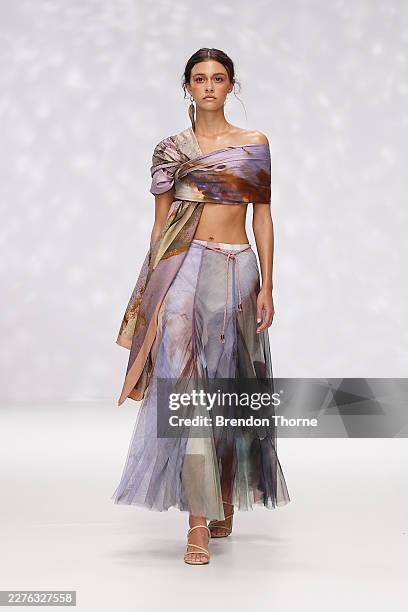
Part of the charge was visual. According to The Sydney Morning Herald’s stage report, she performed in front of 16,000 people and an estimated television audience of 40 million, wearing a gold gown set with 7,000 Swarovski crystals.
Even written down, the detail sounds like a dare. Seven thousand crystals is not a styling choice you make if your aim is tasteful restraint. The costume equivalent of deciding to hold the note a second longer than anyone asked you to. Eurovision rewards nerve as much as melody, and Australia’s best entries have understood that you do not go to Europe to appear sensible. You go to look as if you have mistaken the room for myth and committed anyway.
I grew up with Delta Goodrem occupying a peculiar shelf in the Australian imagination. She was never indie-cool, never the artist you cited to prove your taste at a share-house dinner, yet she remained too capable and too durable to dismiss. Her career has always carried a little extra weather: the piano, the earnestness, the recovery narrative, the sense that every chorus arrives with its own uplift package. Makes her easy to parody if you’re lazy about pop. Also means she understands scale. A flatter performer might have treated Eurovision as a novelty booking. Delta seemed to grasp that the assignment was not to appear game for a camp European detour. It was to make the whole absurd apparatus believe in her for three minutes.
Here is where the Australian context matters. Since Guy Sebastian opened our Eurovision chapter, the country has used this contest as a weird offshore lab for questions we never settle at home. Can mainstream Australian pop travel without apology? Can polish coexist with camp? Can a performer be technically good, emotionally direct and still feel modern? Eurovision lets us ask those things at a safe distance because the whole event arrives wrapped in sequins and plausible deniability. If it goes badly, well, it was only Eurovision. If it goes well, something more tender slips out. We were not just barracking for Delta. We were watching our most sincere pop instincts audition for legitimacy.
At our best, Eurovision lets us test what our own culture is too shy to say aloud.
The run-up helps explain why this entry felt unusually coherent. In an interview with SBS creative director Paul Clarke, he recalled the delegation hearing Eclipse and knowing they had found the song: “Everybody cried, and we went, ‘Eclipse is the one!’” The quote itself is melodramatic in the best possible Eurovision way, but it also suggests discipline. The Australian entries that endure are rarely the ones that split the difference. They pick a mood and stay loyal to it. Eclipse did not pretend to be a self-aware banger or a novelty detour. It committed to lift, glow and a kind of celestial seriousness that could easily have tipped into nonsense. Instead it held.
There was also a practical argument for Delta from the start. Jess Carniel, a Eurovision researcher, pointed out before the final that Goodrem had already done the less glamorous work of building a European audience. “She’s done tours there, and she has cultivated a European audience who are really looking forward to seeing her perform,” Carniel said. The detail shifts the story away from national sentimentality and towards strategy. Australia is still the guest in this room, still managing the structural awkwardness of competing in a contest built on continental proximity and televote habits we cannot fully share. Delta’s celebrity at home was never going to be enough on its own. The point was that her version of fame, unlike some of our domestic institutions, had already travelled. She arrived as more than a local memory. She arrived with some lived-in international context.
Even so, the emotional grammar of the performance remained unmistakably hers. When Goodrem spoke to SBS News during the campaign, she said: “From the day I got into music, I have always believed in the power of music and its healing qualities.” On paper, that sentence reads like the sort of line irony-trained Australians are supposed to recoil from. Healing qualities? Really? Yet that nakedness is part of why she worked.
That sort of nakedness either sends you running or pulls you closer.
I might be wrong about this, but Australia’s relationship with cringe is often just fear in smarter clothes. We are comfortable mocking the performer who tries too hard because effort exposes desire, and desire is embarrassing if you have built your whole personality around taste. Delta’s Eurovision run blew past that defence. She does not sand away the earnest bits before presenting herself to the world. She walks out holding them. In a global pop era that rewards detachment, brand mischief and studied cool, there was something almost rebellious about sending a performer who still seems to mean every syllable. You do not put on a gold crystal gown, sing about eclipse and transcendence, and worry too much about being caught wanting something.
The voting nearly made that argument for her. Australia sat on 165 points before the public vote, according to Rolling Stone Australia’s recap, which is the sort of total that tells you juries could hear the architecture of the whole enterprise. Technique, control, arrangement, staging — the boring words that often sit beneath glamour — all of it registered. The final fourth-place finish then gave the story its odd emotional texture. Had she won, the coverage might have collapsed into triumphalism. Had she bombed, we would have filed the whole exercise under national overreach. Fourth left room for interpretation. It was high enough to feel vindicating and just unfinished enough to keep the conversation alive, which is exactly where the most interesting culture stories usually sit.
There is another reason the performance hit harder than a standard heritage-pop comeback. Australian mainstream pop has spent years living in a strange afterlife: loved domestically, exported in fragments, rarely granted the kind of critical mythology that clings to our rock history or our prestige television. Delta belongs to that middle space. She is too famous to be rediscovered and too easy to underestimate to be canonised without fuss. Eurovision, absurdly, gave her a setting large enough to rebalance that equation. For one week she was not a memory from commercial radio or an old tabloid shorthand for wholesome stardom. She was a disciplined, theatrical adult performer holding a massive room in place.
Which is why this did not feel like a nostalgia trip, even though nostalgia was obviously part of the current. Nostalgia looks backwards and asks you to remember who you were when the song first found you. This run asked a different question. What does Australian pop ambition look like now, after the snobberies have softened a little, after the culture wars over earnestness have become more boring than the earnest people themselves? Delta’s answer was to go bigger, cleaner and stranger. No defensive irony. No attempt to shrink herself into credibility. Just scale, craft and the gamble that people might meet her there.
By Sunday morning, the clips were already looping into that familiar post-event blur, another shared cultural object chopped into highlights, reaction shots and one-line verdicts. But I kept coming back to the peculiar dignity of the thing. Not because Australia almost won. Because for a few minutes on a European stage, Delta Goodrem made a very old local anxiety look small. She sang as if our pop ambitions were not embarrassing, as if grandeur might be allowed, as if the world could watch without us apologising first. I am not sure Eurovision can solve that argument for us. I am fairly sure she made it harder to hide from.

The Lifestyle Desires brief
Style, food, travel and wellbeing — weekly in your inbox.
Subscribe