What cotton country knows about style
Sam Coulton's label began with fibre and farm weather, then grew into a national clothing business. In Goondiwindi, style starts with material, place and staying power.
In most fashion stories, cotton arrives late. By the time it reaches the page, it has already been tidied into fabric, campaign image, something to admire under clean lighting. In Goondiwindi, it shows up much earlier. It appears as weather, acreage, risk and the hard arithmetic of what a season can take from you. That’s why Goondiwindi Cotton holds more interest than the average label profile. Sam Coulton knew the fibre long before he had to think about shop fittings, colour cards or what somebody in Sydney might call lifestyle dressing.
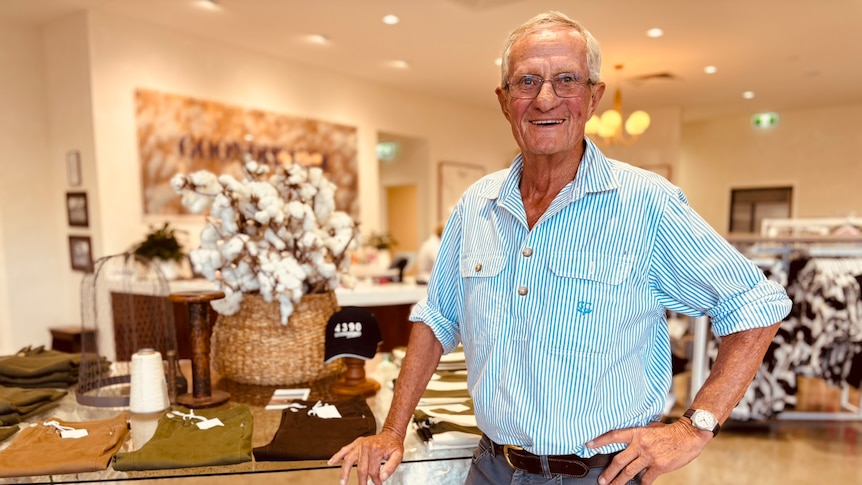
The ABC News profile that pushed this story into the national conversation gives the clean facts: Coulton is 73, the business is 34 years old, the brand is stocked by 220 retailers and produces 60,000 garments a year. All useful. But what I keep coming back to is the material memory underneath them. In 1989, the family sent 212 bales away for processing. A bale isn’t an abstract brand asset. It’s weight, harvest, transport, cash flow. A farm decision. Thirty-four years later, that experiment has become a label with national reach. In a Humans of Agriculture conversation, the move into clothing is framed as adaptation. That sounds exactly right. Farmers learn to adapt or they disappear.
Coulton’s own line in the ABC piece is even plainer: “We need to value add to fortify ourselves from drought.” The sentence never strains for glamour. You can hear the paddock in it. You can hear a man who measures time by seasons and margins, not by sell-through and launch windows. Drought sharpens every decision it touches. It teaches restraint. Patience. A respect for material limits. When those instincts travel into clothing, a garment stops being pure image. It becomes part of a larger argument about endurance, usefulness and how a regional business survives bad years as well as good ones.
Fashion loves authenticity talk. Coulton’s version starts earlier — a crop in western Queensland, a family willing to ask what else their fibre could become.
That earlier starting point is what city fashion people sometimes miss when they look west. They see a neat origin story and a pleasing dose of rural texture. Coulton seems to have built something sturdier. Goondiwindi Cotton carries the polish a national label needs, yet the logic underneath still feels agricultural. Start with the fibre. Keep closer to the source. Hold onto more of the value. Sell clothes people can imagine wearing again and again — not once under flattering lights and then never quite reaching for.
Julia Spicer’s quote keeps snagging in my head: “The retail shop wouldn’t be out of place in Sydney.” The praise is obvious. But the sentence lands because it says something larger about regional taste. A boutique in Goondiwindi can look assured, current and commercially sharp without waiting for a city passport. Regional style can hold its own.
During an Australian Fashion Week cycle, that shift in authority feels fresh. Runway coverage has its pleasures — I’m not above them. Still, those stories usually move from image outward. Coulton’s story moves from material inward. The crop comes first. The clothes follow. Then the shopfront, then the wider mythology around the brand. A slower sequence. To my mind, a more persuasive one. You believe the label because you can trace its line of descent without much effort. The fibre is there at the beginning and stays visible all the way through.
Place matters here too. In Australian fashion writing, the country is still too often treated as backdrop, resource or weekend escape. Here, the authority sits closer to the fibre itself. Place isn’t a styling device borrowed for a season. It’s inside the business from the start.
Springborg’s quote to ABC catches the local feeling in its broadest form: “Rural Australia needs more Sam Coultons. They just do extraordinary things.” Mayors are allowed a bit of sweep. Even so, the line lands because a label like this never belongs only to its founder. Success spreads outward. A shopfront alters the feel of a main street. A known brand changes how outsiders picture the town. A tourism arm turns curiosity into actual visits. Even the story people tell about local cotton starts to change. Then there’s the longevity. Coulton has done this over 34 years. At 73, he’s outlasted enough cycles to know the difference between attention and staying power. Regional pragmatism becomes method at that point. Keep going. Make the next season work. Build the business so it can survive the dull years as well as the exciting ones.
Those retailer and production numbers matter in another way. A brand making 60,000 garments a year isn’t trading on novelty alone. It has to meet real lives, repeatedly. Clothes at that scale need to survive office air-conditioning, country drives, a long lunch, the awkward gap between aspiration and routine. That’s what keeps this story from floating off into myth. The business is big enough to test its own claims every day. If the garments were only a charming idea about regional Australia, the thing would have fallen over years ago. Instead it keeps moving through 220 stockists, which suggests customers found a use for the clothes beyond the story attached to them. Wear is the final edit, and wear has been generous to Coulton.
For lifestyledesires, this is the richest part of the story. We spend so much time talking about labels as mood, as identity, as a set of cultural signals floating free of the things themselves. Coulton pulls the conversation back to the object and the place that formed it. The brand’s own legacy language can edge towards reverence — house writing often does — yet the underlying idea stays solid. Farming brought him to cotton first. Weather came with it. Labour came with it. Drought came with it. Style begins in pragmatism here and still leaves room for pleasure. A regional shop can look polished enough for Sydney. A national brand can keep its provincial accent.
There’s a risk in over-celebrating this kind of narrative. Regional enterprise can be flattened into virtue just as easily as city fashion can be flattened into artifice. Coulton’s achievement feels more interesting than either stereotype. He has built a business people wear, stocked across the country, while keeping the original material story intact. Plenty of brands can invent provenance. Very few can point to the field.
And where does he go from here? The sources suggest continuation, legacy and a further thickening of the world around the label. The retailers keep moving the clothes. The tourism side keeps bringing fresh attention to Goondiwindi. The founder’s age makes inheritance part of the story now, whether anybody says it out loud or not.
What lingers for me is the earlier image: cotton before fashion gets hold of it, a crop carrying the practical intelligence of the people who grow it. Coulton turned that intelligence into a label. Thirty-four years on, it still reads as one of the rare Australian fashion stories that knows exactly where it came from and sees no reason to blur the line.

Sydney-based fashion editor covering Australian designers, runway and the wider AU industry. Previously at Russh and Fashion Journal.
The Lifestyle Desires brief
Style, food, travel and wellbeing — weekly in your inbox.
Subscribe