Four hours to the lagoon: direct to Cocos, finally
On 1 May, QantasLink cut the Port Hedland stopover from its Friday flight to the Cocos (Keeling) Islands. The journey is now four hours, the lagoon is waiting, and the arithmetic of a long weekend has shifted. Cleo Tasman does the maths from a bar stool at the Cocos Club.

The woman at the Cocos Club bar has been on the island for eleven years. She arrived as a short-term nurse, stayed for a man, and by the time the man had gone the place had got under her skin. I ask her what the old flight was like. She laughs, once, and says nothing. Then: “Port Hedland. Two hours on the tarmac. The air-con on the A319 doesn’t work when you’re sitting on the apron at Hedland in February.” She takes a sip of something clear with lime. “You got in at sunset and missed the first dive.”
I have never been to the Cocos (Keeling) Islands. Until about six weeks ago, neither could you, not without a tolerance for six-plus hours of flying that included a refuelling stop in the Pilbara. Two hours sitting in Port Hedland, the cabin warming, watching the refuelling truck through the window, wondering whether the reef would still be in sun when you landed.
On 1 May, QantasLink removed the Port Hedland stopover on its Friday service. The flight is now direct: Perth to Cocos, four hours, no tarmac, no waiting. The Monday flight still stops at Port Hedland, but the Friday one is clean. You leave Perth at lunchtime and you are on West Island in time for the afternoon dive.
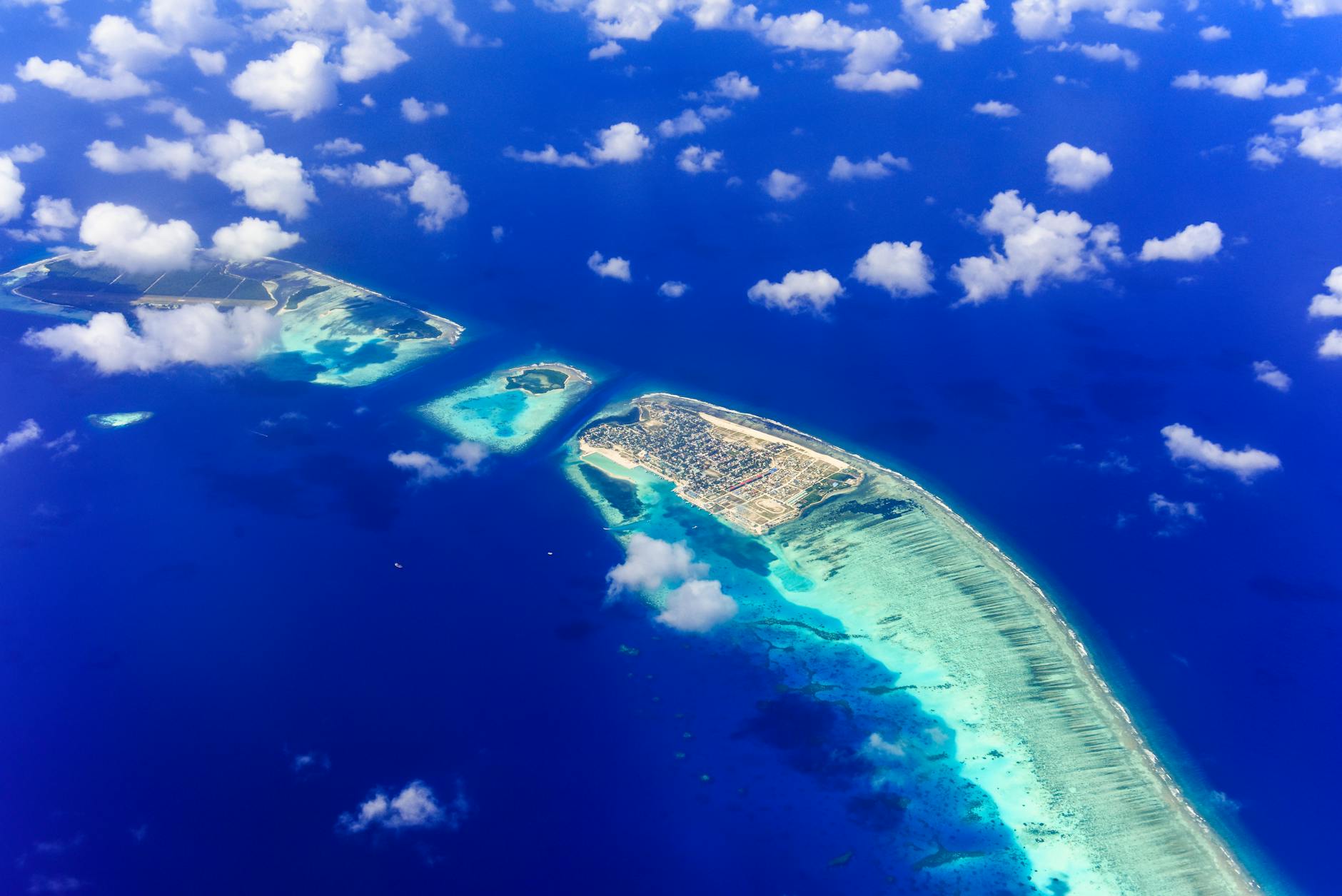
The Cocos (Keeling) Islands are twenty-seven coral islands arranged in a near-perfect circle around a lagoon that is, by surface area, one of the largest marine sanctuaries in the world. Two of the islands are inhabited. About six hundred people live across them, and at any time only 144 visitors are allowed. You book your accommodation when you book your flight or you do not go. There is no overflow.
From the air, the atoll is an unbroken ring of turquoise around a deeper blue centre. Coconut palms run to the water’s edge. Every beach is white sand. The runway on West Island was built to handle the A319s and A320s QantasLink now flies, and the airport terminal is a shed with a fan. You walk off the plane onto the tarmac and the humidity wraps around you like a wet towel you do not mind wearing.
What the old flight used to cost you
The Port Hedland stop was not a secret. QantasLink launched the service on 3 November 2025, part of a five-year government partnership, twice weekly from Perth Terminal 1 on A319s and A320s. It was better than what came before, which was Virgin Australia regional flights that also stopped in mining towns, just on different days. Still, the Hedland stop meant getting in late. By the time you collected a hire car (from about $85 a day, keys left in the ignition because a replacement takes a fortnight), drove the ten square kilometres of West Island to wherever you were staying, and checked in, the light was gone. You missed the first afternoon. Every time.
Now you do not. The Friday flight lands mid-afternoon. That is the difference between a long weekend that feels like two full days and a long weekend that feels like three. For Australians who have been watching friends post Maldives and Bali on Instagram while the Cocos lagoon sat four hours and a mining-town stop away, the shift is not subtle.
The shape of the place
West Island is where visitors stay. It has the airport, the supermarket (prices higher than the mainland, freight costs baked into a tin of tomatoes), the Cocos Club (happy hour 5.30 to 6.30 pm, duty-free bottle shop, you can bring takeaway from Salty’s or Tropika and eat it at the bar), and a handful of places to sleep. Cocos Cottages looks over the runway and the golf course, about $400 a night for a self-contained two-bedroom. Breakers does self-contained bungalows for about $310. Neither is fancy. Both are booked weeks ahead.
Home Island is a thirty-minute ferry ride from West Island. About 450 people live there, most of them Cocos Malay, a community with a language descended from the workers brought to the islands by the Clunies-Ross family in the nineteenth century to harvest coconuts. There is a mosque, a kampong, a halal restaurant called Tropika that does $12 lunch specials and is open every day. There is also a homestay, Cocos Kampong, about $160 a night, simple rooms with a shared lounge and kitchenette, where the host will cook you traditional Cocos Malay food if you ask.
Direction Island is uninhabited. A ferry runs Thursday and Friday, $5 return. You walk a trail through the palms to The Rip, a channel where the lagoon water pours out to the open ocean. Snorkelling it is a drift. You enter at one end, let the current carry you through, climb out before the open sea. Confident swimmers only. The current does not care whether you have done this before.
The water
Cocos Dive is the only dive centre on the islands. It runs trips every day to more than twenty-five sites inside the lagoon. The water is warm, the visibility long, the reefs uncrowded. You swim with manta rays. You see green turtles, dolphins, sharks, tuna, schools of reef fish bright enough to look fake. The lagoon has been a marine sanctuary long enough that the fish do not flinch when a boat passes over them.
Kitesurfers come for the trade winds between March and July. The lagoon is flat and wide and the wind is consistent. You can hire a dinghy from Cocosday Fishing and Boat Tours without a skipper ticket and putter between the uninhabited islands, stopping where you like. No one will ask what you are doing. The visitor cap of 144 means the islands absorb people quietly.
On land, Phat Tours Cocos rents e-bikes and runs guided rides around West Island. There is a golf course. There is a bakery called Salty’s that does stone-grilled pizzas and locally caught fish and chips on Tuesday, Friday, and Sunday nights, and coffee from 7.30 am. There is a brewery, Surfer Girl, alfresco, sunset views, themed cuisine nights, open Monday to Thursday and Sundays. There is a restored barge called The Big Barge Art Centre that serves coffee on Tuesday and Wednesday mornings between nine and eleven. The galleries here do not keep retail hours.
What you need to know
The Cocos Islands are an Australian external territory. You do not technically need a passport, but you should bring one anyway. If the flight has to divert to Jakarta for a medical emergency, you will want it. You fill out an immigration form on arrival. The flight departs from Perth’s Terminal 1, the international terminal, though it is a domestic route.
The dry season runs May to October. Cooler, less humid, fewer cyclones. This is when you want to come. The rainy season, from November to April, is hotter and wetter, though the trade winds that kitesurfers chase blow strongest at the tail end of it.
Reef shoes. A reusable water bottle and electrolytes. Marine-friendly sunscreen and mosquito repellent. A snorkel and fins if you have them (you can hire them on the island but the supply is finite). Groceries if you can spare the weight. The supermarket on West Island has the range you would expect for a town of six hundred people, priced for freight. What you do not pack: expectations of resort service. There are no resorts.
The minimum stay is four nights, though seven is better. Flights run twice weekly, and if you miss one you are staying. The Cocos Club will be open.
A four-hour gamble
I have been watching the prices. They are not cheap. The direct Friday service costs more than the Monday flight that still stops at Hedland, which is predictable but annoying. From the east coast the connection works if you fly to Perth in the morning: early departure out of Sydney or Melbourne, cross the continent, board the afternoon A319, land on Cocos before dark. It is a long day. It is also, if the maths works in your favour, a three-day weekend on an atoll.
The thing I keep turning over is whether four hours changes what the islands actually are. Cocos has always been undersold, not under-loved. The 144-visitor cap is not a policy lever someone in Canberra decided on. It is a physical limit. There are only so many beds, and nobody is building more. Two flights a week, a few dozen seats each. The place cannot be overrun the way a coastal town gets overrun because there is nowhere to put the people. That is the quiet genius of it. The cap enforces itself.
I asked the nurse at the Cocos Club whether she worried about the direct flight changing things. She looked at me like I had asked whether she worried about the tide. She said the first direct Friday flight landed at 3.15 pm and by four o’clock there were twelve people in the water off Direction Island. Twelve people, she said, in a lagoon the size of Sydney Harbour. Then she finished her drink, walked out into air that smelt of salt and frangipani and nothing else, and I sat there doing the maths and not coming up with a reason to stay home.
Cleo Tasman
Hobart-based travel writer chasing regional Australia, off-grid stays and the slow road.