What Dua Lipa’s bridal suit knows about weddings
Dua Lipa bridal suit moment shows why brides are moving toward separates, repeat wear and ceremony clothes that feel like themselves.
The wedding photo that stayed with me was not the kiss, or the confetti, or the little theatre of two famous people pretending they had not clocked the cameras. Instead, I kept looking at the white tailoring on the steps. Shoulder enough to hold its own. Skirt without a train dragging behind like a family obligation. Hat with drama, yes, but no apology.
On a town-hall staircase, a white suit can tell you more about bridal style than a ballroom gown ever could. After Dua Lipa walked out of Old Marylebone Town Hall with Callum Turner on 31 May, the image travelled because it had celebrity-wedding wattage. Maybe it stuck because it looked, in a strange and useful way, like clothes.
Fair counterargument: celebrity fashion has always been brilliant at making one outfit look like a movement. One famous woman wears ivory tailoring, the trend pieces arrive, and somewhere a bride who already owns a blazer wonders whether she is now accidentally zeitgeist-adjacent. None of that makes the shift fake. Precision matters here; the interesting question is what is actually moving.
The suit is not anti-romance
A lazy reading says the bridal suit rejects the princess gown. Too neat. Really, it rejects the idea that wedding clothes have to turn a woman into another genre of person for the day. Severity is not the appeal. Recognisability is. You can still see the bride inside the outfit.

For that reason, Dua Lipa’s Schiaparelli look feels bigger than a celebrity wedding. The Guardian’s fashion desk framed it as part of a bridal-suit revival, though suits have returned several times. More useful, I think, is asking why this version feels emotionally legible now.
My guess: many women are tired of the bridal costume test. Beauty, ceremony, the theatre of putting something extraordinary on your body; none of that is the problem. The problem is being told that the extraordinary thing must be fragile, enormous, once-only expensive, and slightly unrelated to the life you live on every other day.
Tailoring gets around some of that without announcing itself as practical. It is still special. Clean in a photograph. Capable of carrying a hat, a veil, a red lip, a pair of ridiculous shoes. Crucially, it also lets a woman sit down, walk outside, hug her friend, get into a car, move through a registry office, then possibly wear the jacket again with jeans six months later. That last bit sounds unromantic until you think about how much romance there is in wanting a wedding garment to stay in your life.
Bianca keeps walking back in
Bianca Jagger is the ghost in the room. Always. In 1971, she married Mick Jagger in Saint-Tropez wearing Yves Saint Laurent tailoring, and the image has spent 55 years doing that rare fashion-history thing: refusing to become dusty. Vogue read Lipa’s look as an explicit homage to the original cool-girl bride, which is true and slightly funny, because every generation seems convinced it has discovered Bianca first.

Chicness is not why the reference endures. Plenty of people have looked chic at weddings. Bianca looked unborrowed. Those clothes seemed to belong to her body and her temperament, not to an inherited script about what a bride should resemble. Fashionable is one thing. Unborrowed is rarer.
Henrietta Rix, the Rixo co-founder, put it neatly in the Guardian’s piece:
“Jagger’s look encourages modern-day brides to be authentic to their style, experiment with separates or different shapes, and most importantly feel confident on their wedding day”
Henrietta Rix, quoted by the Guardian
Authentic is a word I distrust when fashion leans on it too often. It can become a soft little slogan, useful for selling anything from linen trousers to perfume. Here, though, it has a practical edge. If your normal wardrobe is built around tailoring, sharp shoulders, crisp shirts, vintage jackets or neat little skirts, a cloud of tulle might not feel like aspiration. It might feel like drag.
No criticism of tulle intended. A gown can be as personal as a suit. I have seen brides look entirely themselves in silk, beads, organza, a dress cut so close it seems poured on, a dress so big it arrives five seconds before they do. Trouble starts when one silhouette is asked to own the whole emotional category of bride.
The Australian bride is already halfway there
Here the story becomes less about Dua Lipa and more about women standing in fitting rooms with phones full of screenshots. ELLE Australia’s version of the story was useful because it translated the celebrity image into the language of actual styling: separates, proportion, confidence, the clothes around the ceremony rather than only the single entrance shot. Naomi Smith, ELLE Australia’s fashion director, called Bianca Jagger’s bridal suit “one of the most iconic wedding looks of all time”.

“Bianca Jagger’s bridal suit is one of the most iconic wedding looks of all time”
Naomi Smith, ELLE Australia
Australian weddings have their own weather logic, quite separate from the northern-hemisphere fantasy machine. Garden ceremonies where grass eats stilettos. Beach vows with wind that hates veils. Winery lunches stretching into cold evenings, registry weddings followed by oysters, second-day gatherings where the bride wants to look like herself, only better slept and better lit.
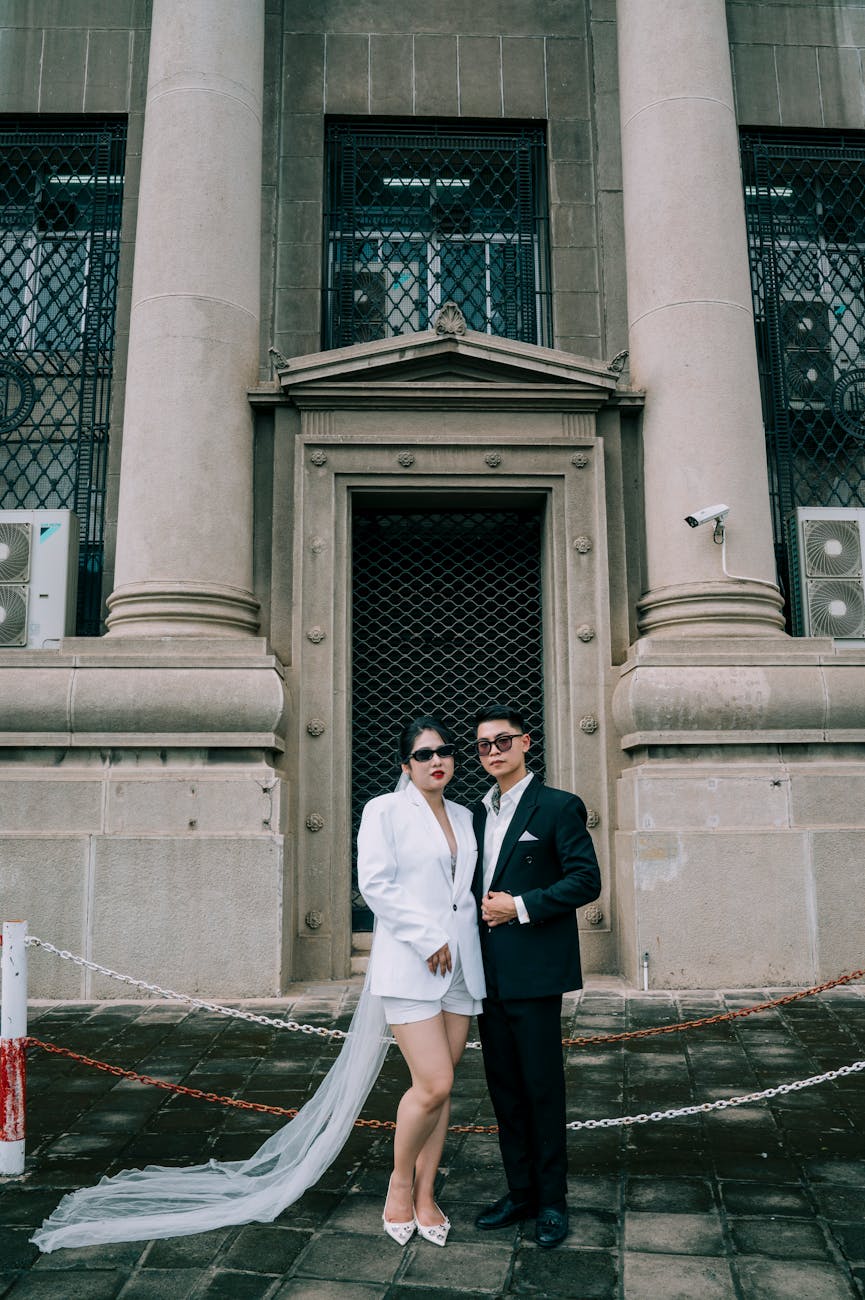
Within that landscape, a suit makes sense. So do separates, a skirt set, a waistcoat, a silk trouser with a jacket thrown over the chair by dessert. None of this requires the bride to perform chill minimalism if she is not a chill minimalist. The best versions still have drama. They just move the drama away from volume and into line.
This is the part I find persuasive. Bridal tailoring is not a uniform for women who reject weddings. Instead, it is a tool for women who want to edit the wedding’s demands. Keep the ceremony. Keep the photograph. Keep the white, if white still feels good. Lose the feeling that the garment is wearing you.
Bridal labels now have to decide whether this is a real wardrobe category or a novelty rack next to the reception minis. Offered as a gimmick, the suit stays a celebrity image. Cut with the same seriousness as the gown, with attention to shoulder, sleeve, fabric weight and what happens when someone sits down, it becomes a genuine option.
The problem with copying cool
A trap sits inside all this. The Bianca reference is so strong that it can flatten everyone who follows her into tribute-act territory. Lipa could get away with it because Schiaparelli gave the look enough current charge, and because pop stars are professionally equipped to metabolise references. Most people are not trying to get married as a fashion footnote.
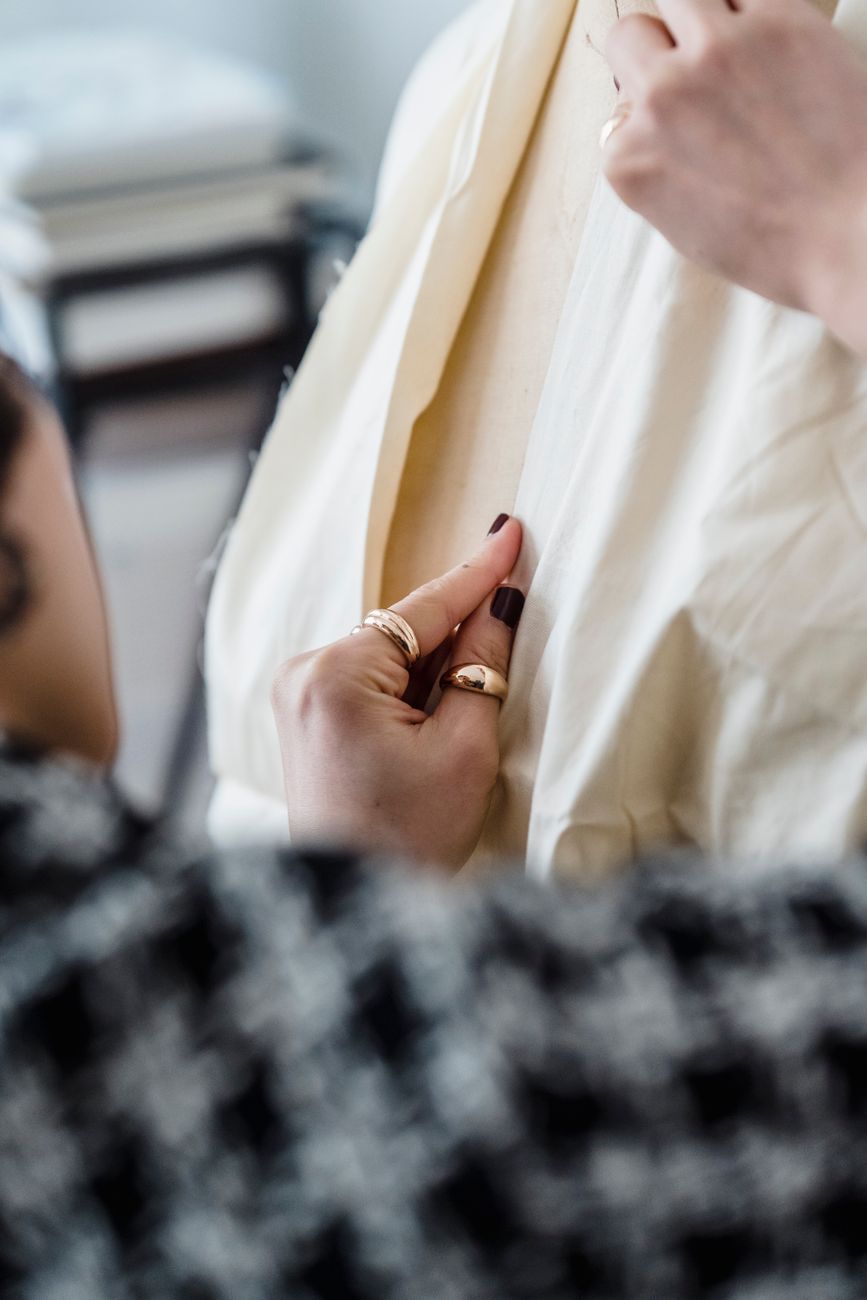
Better lesson: do not simply wear a bridal suit. Ask which part of the wedding outfit feels like you are still there. For one bride, that might be a cropped jacket over a slip dress. Another might want trousers and a sheer blouse. Someone else might choose a completely traditional gown with one strange earring, boots, or a jacket tossed on later when the temperature drops and everyone is on the dance floor sweating through the speeches.
Fashion commentary often wants a clean decree. The gown is over. The suit is back. Brides are changing. I am less convinced by the neatness. Loosening seems more plausible. The wedding wardrobe is becoming less obedient to one climactic outfit, and more open to chapters: registry look, ceremony look, lunch look, late-night look, the piece you actually keep.
Celebrity culture likes that shift because photographs travel in chapters too. Vanity Fair and Marie Claire both treated Lipa’s civil ceremony look as part of a larger wedding-style narrative, not the whole story. Modern bridal dressing now lives in public as a series of images that can be read, saved, argued with, repinned and adapted.
For ordinary brides, that can be exhausting. Liberation is in there too. You do not have to find The Dress if the dress was never the right question. You can find the jacket. The skirt. The line of a sleeve. The hat you are almost too embarrassed to want. The thing that makes your mother pause, then admit it looks like you.
A ceremony garment you can live with
What keeps pulling me back to Lipa’s town-hall suit is its portability. Not casualness. Portable ceremony, if that is not too odd a phrase. The outfit held the symbolic weight of a wedding without becoming a museum object the minute the papers were signed.
Maybe that is the mood shift. Modern brides are not necessarily less romantic than their mothers or grandmothers. They might just be more suspicious of romance that requires total disappearance. Any useful fantasy now has to leave room for a body that moves, a woman with a pre-existing wardrobe, a life that continues after the confetti has been swept into the gutter.
Bianca Jagger remains the reference because she offered a way to look bridal without looking absorbed by the role. Dua Lipa’s version works because it understands the same thing from a different decade: persuasive wedding clothes do not erase the wearer. They sharpen her.
I do not think the bridal suit will replace the gown. It does not need to. Replacement is not the point. Permission is. A good suit widens the room. It tells the bride who never saw herself in a princess skirt that she is not opting out of the ceremony. She is choosing the version that lets her arrive as herself.
So the image feels bigger than a celebrity wedding. Not because everyone will copy it, though plenty will try. Because for a few seconds on a London staircase, bridal style looked less like a rulebook and more like a wardrobe door left open.

The Lifestyle Desires brief
Style, food, travel and wellbeing — weekly in your inbox.
Subscribe