What a sari can say before you do
A young writer's account of her grandmother's sari opens onto the quieter labour of mixed-race life in Australia: self-editing, inheritance and the cost of seeming easy to read.
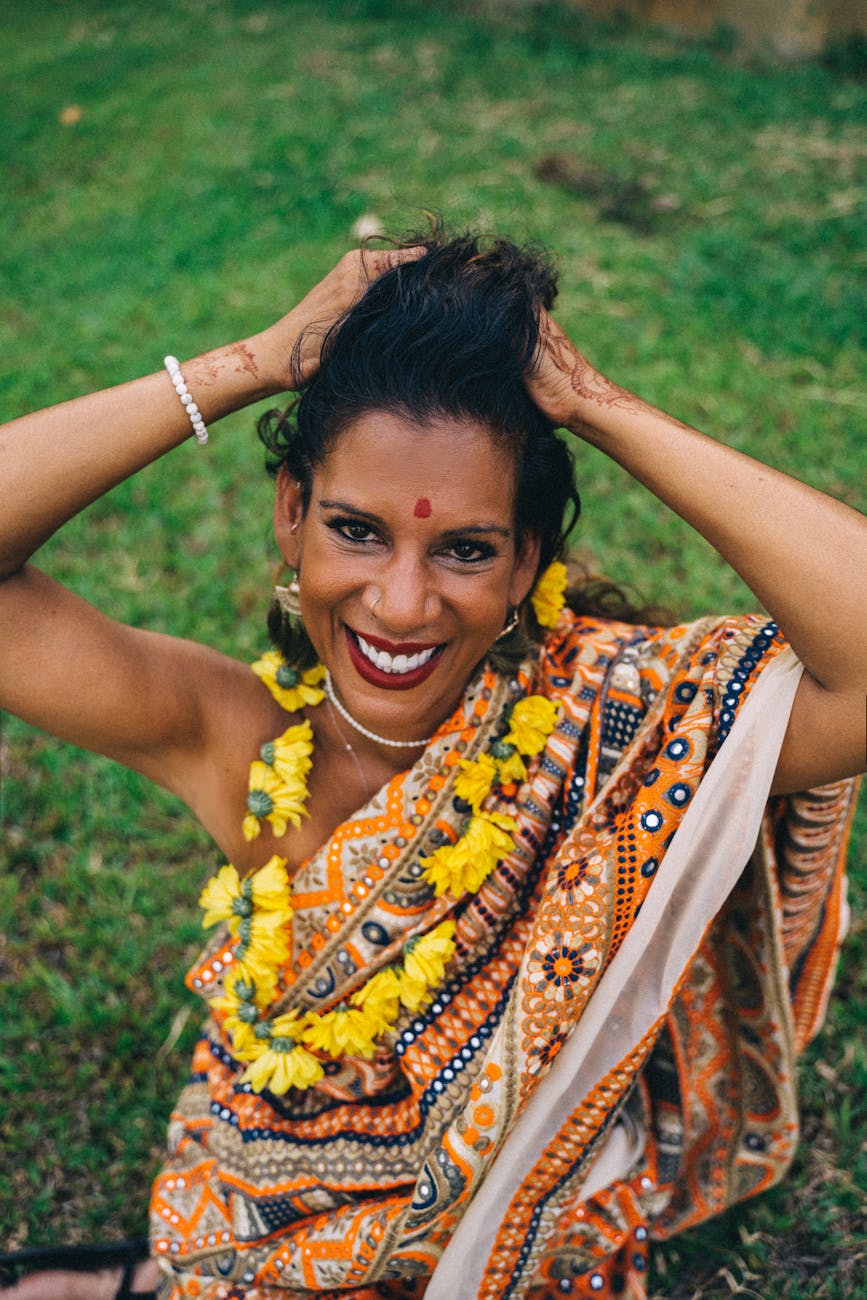
Some clothes arrive before the person wearing them. I kept coming back, this week, to the image at the centre of Neesha Sinnya’s Sydney Morning Herald essay: her grandmother, Maa, in a sari every day, moving through family memory with the kind of steadiness that makes everyone else look a bit temporary. Before there is an argument about identity, before there is the clumsy Australian question about where you’re really from, there is cloth, colour, routine. A woman who has decided what the day looks like. A granddaughter learning that family history can be visible before you say a word.
That last part. That’s the thing I can’t let go of.
Not the broad, glossy multiculturalism wheeled out for safe speeches. The smaller, less flattering thing. The editing. The private arithmetic. The way a mixed-race kid clocks, very early, which details are safe to offer up and which ones will tilt the room. Sinnya writes, “For me, it seemed easier to try and do my best to fit in with my predominantly white Australian peers than to open up the Pandora’s box that was my Nepalese heritage side.” Plenty of people will recognise that sentence, I think, even if their own family details sit elsewhere. Passing isn’t the whole trick. The trick is pre-empting.
Maybe that’s why the numbers land hard. Her father arrived in 1988, when only 0.2 per cent of Nepalese immigrants had come before the nineties. Another fifteen relatives followed. Those are census-line items on the surface. Underneath, they’re the emotional floorplan of a household built a few beats ahead of the suburb around it. When you’re one of a tiny handful of families carrying a language, a set of smells, a way of greeting elders that has no obvious parking spot in Australian life, the pressure to file down the edges stops being abstract. Posture absorbs it. Your register. The selective quiet of a kid who figures out, early, that explanation costs energy.
Five words.
That’s what Sinnya managed before her grandmother died: “I only managed to learn a total of five words before she passed away.” Not because she didn’t want more. Because families in that position spend years translating themselves into the dominant culture, and it’s only later — when adulthood arrives with its particular griefs — that you notice what got left behind. Language disappears in a hundred small surrenders, not one clean break. English at school. English in public. English because it’s faster. English because you’re exhausted. Then the person who held the older words is gone, and all you have are fragments and the queasy sense that you arrived late to your own inheritance.
Here’s what I respect about the essay: it doesn’t try to iron this into a tidy belonging story. God knows the Australian appetite for neat uplift is bottomless. The messier truth is that mixed-race life often looks less like a revelation than a long, uneven shedding of reflexes you didn’t know you’d acquired. You stop laughing along with jokes you once decided were harmless. You notice how often people praise you for being “so Australian” when what they’re really saying is legible to me. Embarrassment is a habit, and habits do not dissolve just because you’ve since collected the words to name them. At 26, Sinnya isn’t writing as anybody’s mascot. She’s trying to stand still inside her own life without sanding bits of it down first.
Standing still matters because the experience isn’t fringe, even if the language for it in public still feels thin. Western Sydney University’s mixed-race project estimates about 7 per cent of Australians are mixed-race. The project’s framing is careful: this cohort is frequently undercounted, misread, or treated as though it materialised last Tuesday. The official line is that multiculturalism answered the big question and the rest is detail. Belonging, though, is detail. Surnames people fumble, lunchbox diplomacy, the split-second call about whether correcting someone’s pronunciation is going to cost you more than letting it slide — that’s where it lives. A census box can’t record the daily choreography of deciding how much of yourself to bring into a room. But then, maybe it was never meant to. Maybe the problem is that the public conversation keeps asking mixed-race Australians to supply clarity where the culture itself prefers blur.
A recent paper on inheriting racial privilege and oppression through proximity gives that blur a formal name. The academic language sits heavier than the thing it’s describing, but the shape is familiar: people who move between lineages can inherit contradictory social readings all at once. Safety in one room. Suspicion in the next. Occasional permission to slip through unnoticed. Then the jolt of remembering you’re still being watched, sorted, deciphered. The tidy diversity-speak doesn’t know what to do with that. Mixed-race life isn’t some clean perch above the fray. Closer to weather, really. Conditions shift by suburb, by school gate, by workplace, by how much confidence you woke up with.
Maybe that’s why so many of these stories circle back to the body. Clothes. Hair. Skin. Names. They walk into a room long before anything interior does. Maa in her sari isn’t just a family snapshot. She’s an object lesson in what it costs to be visibly tethered to somewhere else — in a country that warmly congratulates itself on openness while still rewarding looseness, ease, the studied capacity not to make anyone too curious. I don’t think the pressure is usually violent. Banality is what makes it slippery. The half-beat pause after your surname. The surprise at your accent. That particular congratulatory tone reserved for people who present as familiar enough. Accumulative things. The kind of social weather that trains a kid to edit first and figure out why later.
You can hear an echo of that in Maria Thattil’s essay about wanting to “wash away the brown” so she could fit in.
Not inclusion. Erasure.
The title alone tells you how savage the assimilation fantasy can get. Sand off the visible bits, keep the pleasant fragments, make yourself easy to decode. Families differ, obviously. Nepalese isn’t Indian, public life in Sydney doesn’t run on the same register as public life in Adelaide, and a beauty queen’s memoir lands differently from a young writer thinking about her Maa. But the emotional grammar feels kin. Mixed-race Australians keep being asked, one way or another, to treat heritage as acceptable only when it’s ceremonial. Occasional. Entertaining. Wear it to the festival. Bring it out for Harmony Week. Translate it into something the room can compliment. Just don’t let it change the mood on an ordinary Tuesday.
Ordinary Tuesday. That’s the battleground.
I keep thinking about the weekday version, not the official one. The version where you decide whether to correct the teacher, whether to cook the thing that makes the kitchen smell like home, whether to answer honestly when honesty is going to generate five follow-up questions and a slightly altered tone. Kids develop a genius for this reading. They learn the gap between curiosity and scrutiny. They learn when admiration is just a softer kind of distance. By adulthood the reflex can feel like breathing, and that’s the unsettling part. You’re not lying, exactly. You’re just keeping the friction manageable. Then years click over and you realise how much stamina it’s taken to be your own full-time translator.
This is why I’m less interested in the culture-war register than the domestic one. A grandmother’s sari. A father landing in 1988. Five inherited words that never made it to fluency. Fifteen relatives following behind, building out a family geography the kid at the centre of it still had to learn to occupy without apology. None of these are slogans. They’re intimate facts. They show how belonging gets assembled from repetition and routine and being witnessed. They also show why shame hangs around. If you spent your formative years treating one side of your family as a Pandora’s box, adulthood doesn’t arrive with a reset button. It’s more like physio.
Slow. A bit mortifying. Repetitive. Non-negotiable.
Sinnya writes that “being mixed-race can be your superpower.” I get what she means, and the phrase still makes me wince a little. Superpower language feels too glossy for a life that’s often threaded with grief, code-switching and the low-grade exhaustion of being interpreted in public. But if I knock her point into plainer words, it holds. Maybe the gift isn’t exceptionalism. Maybe it’s range — the capacity to clock how identity gets staged, to hear the discomfort in other people’s scripts, to build a self that’s less obedient to the narrow categories on the table. Or maybe the real thing is simpler. You hit an age where you stop burning your best energy on making everyone else comfortable with where you come from.
That’s the pivot her essay seems to catch. Not a final arrival — nobody gets one of those — but a decision to stop shrinking in advance. A willingness to let the history be visible. To let the sari register in public, even if other people misread it at first. To name the loss alongside the pride. To say, without polishing it, that mixed-race life in Australia can hold closeness and dislocation in the same breath. I might be wrong, but that lands harder than another sermon about representation. Sounds like the start of adulthood, or at least the beginning of it: the moment you quit editing yourself for the room and start asking whether the room is worth the work.

The Lifestyle Desires brief
Style, food, travel and wellbeing — weekly in your inbox.
Subscribe