Why the Ord River still feels like a trip you disappear into
On the Ord River, the luxury isn't polish but distance: 55 kilometres of water, wildlife and Kimberley light that make most Australian travel feel over-programmed.
Most Australian travel now comes pre-narrated. You land with the angle already half-written: the infinity pool, the tasting menu on its best behaviour, the lookout where everyone poses roughly the same way. What pulls me toward the Ord River and Lake Kununurra is the quiet suggestion of a place that still slips that grip. In the official material, the river is wetlands, wildlife and light spread across an absurd amount of country. In The West Australian’s profile of guide Jeff Hayley, it sharpens into something subtler: a day that lengthens on purpose, with current and temperature and birds doing as much of the storytelling as any human can.
I’ve been chasing travel-through-one-person all month — a single guide, a single stretch of water, rather than a frantic stack of recommendations — and the Ord slides neatly into that frame. You can feel the shape of the experience without reducing it to a highlights reel. The appeal isn’t novelty. It’s surrender.
Space, out here, is the luxury.
Hayley co-founded Triple J Tours and he seems to understand that instinctively. Triple J calls the river run 55 kilometres, the longest continuous daily river cruise in Australia. I like that number. It does more than decorate the brochure — it tells you what kind of day this is. Fifty-five kilometres is enough for your mind to unclench. Enough for a river trip to stop behaving like an activity and become a condition. You’re carried through a long stretch of Kimberley country instead of being shuttled between moments designed to prove you had fun.
Pace, in travel, is almost everything.
In the West piece, Hayley reads as the kind of operator whose expertise is half logistical, half atmospheric. He knows the practical shape of the water — obviously — but he also knows when a fact should land as a story and when it should stay unforced. “I could write a book about this,” he says, which is a lovely throwaway because it gestures at depth without straining for grandeur. Plenty of guides know a place. Fewer know how to make you feel the place exceeds the guide, the boat, the day itself. That’s the rarer thing. It’s what separates regional travel you remember from regional travel you merely complete.
And then there are the freshwater crocodiles.
They bring the kind of tonal correction a place like this needs. Hayley says of the freshies, “They don’t see us as food” — calming only if you choose to hear it that way — and later adds, “When it drops to 21C, they come out to warm up”. I love those details. They refuse abstraction. Suddenly the river isn’t just beautiful, or remote, or expansive. It has a daily logic of its own. Temperature matters. Animal behaviour matters. Your perspective becomes one small thread in a much larger system, and that’s usually when a destination stops being a postcard and starts to feel actual.
The same current runs through the tourism copy, which is a relief. Visit Kununurra’s own Ord River page and Australia’s North West’s regional overview both present the river as birdlife, wetland edges, huge calm. So much domestic travel marketing has learnt the language of optimisation — conquer a region, tick its icons, leave with a full camera roll and a mild sense of administrative success. The Ord seems happier to let the day breathe. Sit in the boat. Watch the banks alter by degrees. Feel the hour cool. See what the country gives you when nobody’s trying to wring a climax from every twenty minutes.
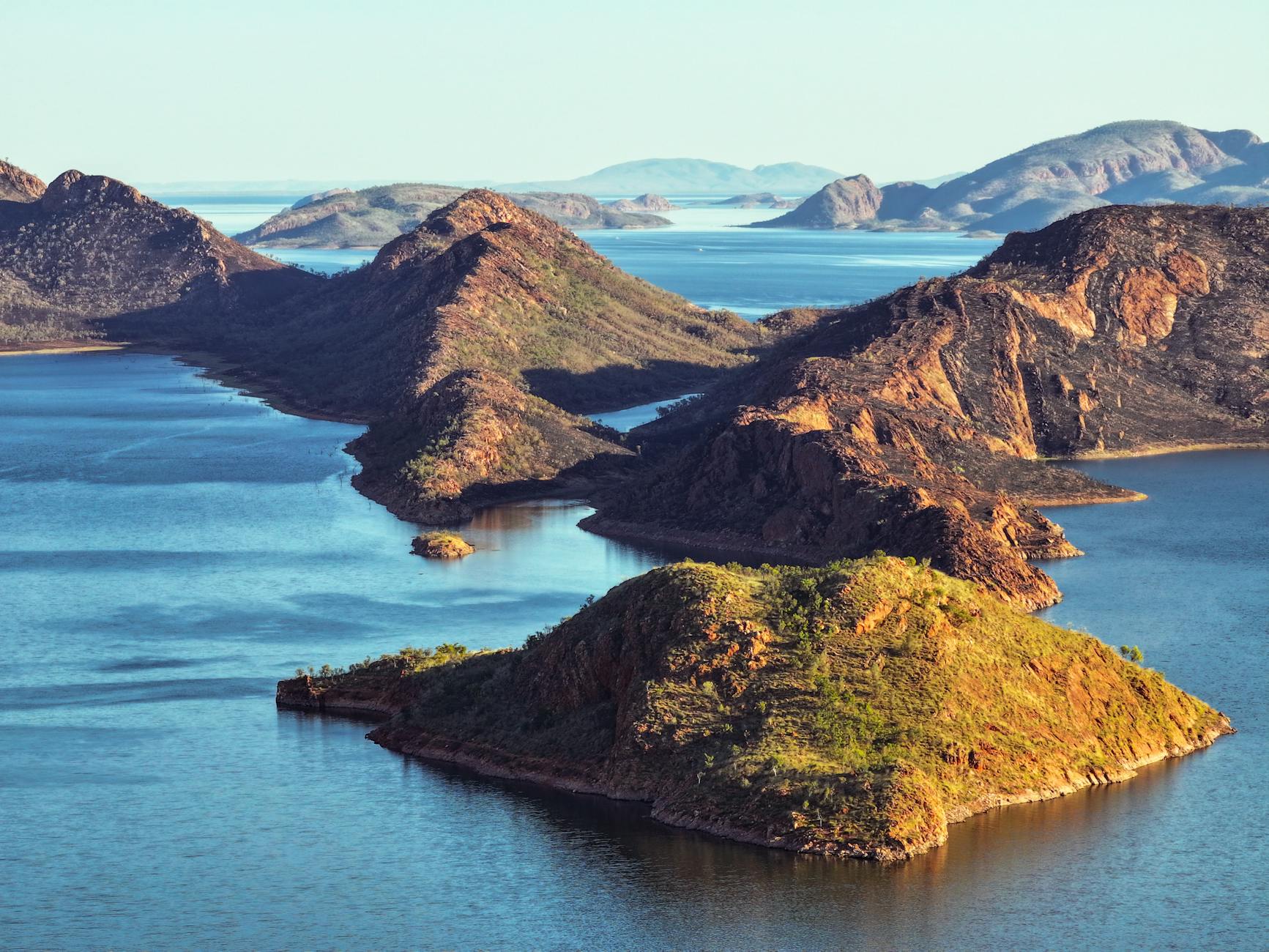
That slow promise sharpens once you remember the river is also engineered country. The Bureau of Meteorology’s description of the Ord region notes the system travellers encounter today was transformed by dam construction between 1969 and 1972. Lake Argyle became the great storage body at the centre of the scheme, and in the West piece its scale gets rendered in a wonderfully Australian way: about 20 times the volume of Sydney Harbour. I find that tension clarifying. The Ord is waterway, infrastructure, habitat and tourism drawcard all at once. It carries the dream of remoteness, and it also carries the mark of planning, regulation, use. That layered identity makes the place feel more substantial to me — not a fantasy staged for outsiders, but a lived system visitors are allowed to enter briefly.
The bit that stays with you
Maybe that’s why the romance holds.
The Ord River Floodplain Ramsar site is a reminder that what visitors admire from a boat is tied to a broader wetland ecology that matters beyond the visitor economy. I’m not trying to preach — environmental significance doesn’t make a destination automatically virtuous, and tourism has a habit of turning living places into mood boards. But the knowledge changes the texture of the trip. Birdlife on the floodplain, crocodiles tracking temperature, water moving according to season and management: those details pull the Ord away from generic scenic beauty and back into something else. A place, not a backdrop. A place has claims on you.
Regional Australian travel has been strongest lately when it offers exactly this kind of concentration. One river. One operator. One clear shape to the day. Readers are sick of the roundup voice that treats an entire region like a shopping aisle. They want a guide with memory, a landscape with edges, an itinerary that leaves some blank space around the experience. The Ord, from the evidence, seems to understand that appetite without flattering it too hard.
There’s also something persuasive about the modesty of the promise. The trip doesn’t ask you to master the whole Kimberley as an idea — which would be absurd. It asks for attention to one passage of water and the guide who has spent decades reading it. That narrowness is a strength. A single-thread journey carries more atmosphere than a three-day sprint through “the best of” anywhere, because your memory has somewhere to land. You remember a line said offhand. The odd comfort of hearing the crocodiles aren’t interested in you. The feeling of a river run lasting long enough for the rest of your life to fall briefly out of frame.
A trip like this can be flattened once it enters the bucket-list machine. I hope it doesn’t.
What the Ord River sounds like, to me, is a form of Australian travel that’s getting harder to find: spacious, guided but unrushed, structured enough to feel held and loose enough to let your mind wander. That’s what I hear in Hayley’s appeal. The 55 kilometres matter. The wildlife matters. The managed water and the floodplain ecology matter. And beneath all that detail there’s a simpler seduction. For a few hours, the river makes the usual over-programmed version of travel fall quiet. You go with it, the light shifts, and the country grows large again.

The Lifestyle Desires brief
Style, food, travel and wellbeing — weekly in your inbox.
Subscribe